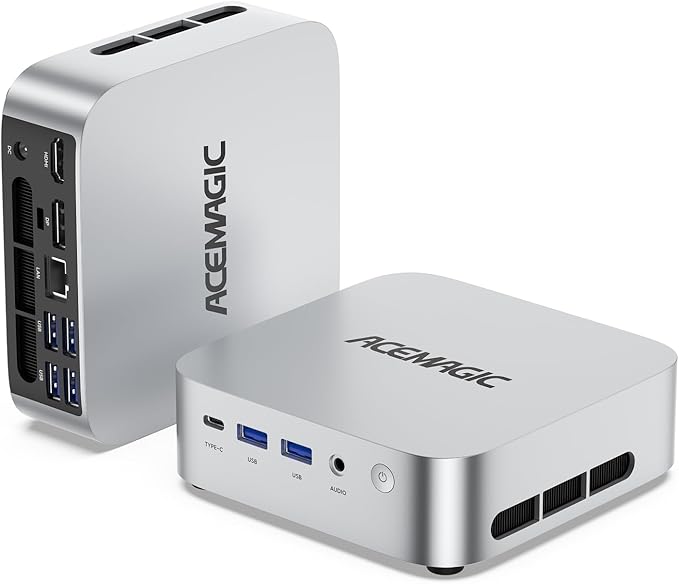

- ACEMAGICIAN M1 Mini PC with Ryzen 7 6800H, 16GB LPDDR5 & 512GB PCIe SSD—compact power for office, programming, and smooth multitasking on Windows 11 Pro.
- Enjoy 4K triple-display output plus 2.5G LAN, WiFi 6, BT 5.2, and fast USB 3.2/Type-C—ideal for productivity, media, and light gaming in a tiny footprint.
- Based on the review snapshot provided, there is no clear pattern of “serious” widespread complaints (e.g., safety hazards, mass failures, or a broad scam allegation) about the ACEMAGICIAN M1 Mini PC—most feedback emphasizes speed, quiet operation, and strong everyday performance.
- The most notable negative signal is intermittent connectivity/driver trouble (reports of WiFi/Bluetooth not working and drivers not helping), which can feel severe if it affects core use cases.
- Other negatives appear more like “expectation gaps” than red flags—such as needing the right display cable/port choice (e.g., HDMI) and minor build/material preferences.
- If you rely on rock-solid wireless (WiFi/Bluetooth) for work, plan for basic troubleshooting or a fallback (USB WiFi dongle, Ethernet) to reduce risk.
- This product is positioned as a compact, high-performance Ryzen 7 6800H mini PC for office productivity, media, and light gaming.
- The key “rumor risk areas” for this category usually involve drivers/support and long-term reliability more than raw performance.
- Product Overview
- ACEMAGICIAN M1 Mini PC Review: Honest Findings
- Positive Feedback & Highlights
- Negative Reviews & Rumor Analysis
- WiFi/Bluetooth Not Working: Driver Complaints That Can Feel “Serious”
- Display Output Confusion (HDMI/DP/Type‑C): Not a “Rumor,” But a Common Pitfall
- Overheating, Fan Noise, and Thermal Throttling: Rumor Check
- Build Quality, Materials, and “Feels Cheap” Concerns
- Windows 11 Pro Legitimacy Rumors: Common Category Concern, Not Shown in Your Snapshot
- Who Should Consider ACEMAGICIAN M1 Mini PC?
- Conclusion: Final Verdict
Product Overview
The ACEMAGICIAN M1 Mini PC (refined title) is a small-form-factor desktop built around the AMD Ryzen 7 6800H (8 cores/16 threads, up to 4.7GHz) with 16GB LPDDR5 memory and a 512GB PCIe SSD. In plain terms, it aims to deliver laptop-class high performance in a tiny desktop box, targeting office workflows, home theater use, and even “mini-server” style roles. The listing also emphasizes modern connectivity—5× USB 3.2 ports plus a Type‑C Gen 2 port (10Gbps) with DP 1.4 display output and PD charging support, 2.5GbE LAN, WiFi 6, and Bluetooth 5.2—along with triple-display 4K output (HDMI + DisplayPort + Type‑C).
The integrated GPU is AMD Radeon 680M, which is typically considered one of the stronger integrated graphics options for its generation. That matters because it can make light gaming and 4K media playback more realistic without needing a dedicated graphics card. Storage expansion is presented as flexible: you can add a 2.5″ drive (up to 4TB) in addition to the included SSD. Finally, the brand promises a 12‑month assurance and 24/7 support, which is relevant when assessing “serious complaint” risk—mini PCs can be great value, but support quality often determines whether a rare issue becomes a major headache.
- Most provided feedback clusters around smooth performance, fast boot/response, quiet operation, and good thermals.
- Within the snapshot, complaints exist but appear limited—suggesting high satisfaction with a few notable exceptions.
ACEMAGICIAN M1 Mini PC Review: Honest Findings
Looking only at the review summary you provided, the overall “story” is that the M1 mini PC is impressing buyers in the areas that typically matter most day-to-day: responsiveness, stability during multitasking, compactness, and noise levels. Customers repeatedly mention it “runs smoothly with no lag or stutter,” boots quickly (often around the “under ~15 seconds” range in anecdotal comments), and remains quiet even under load. Those are meaningful signals because mini PCs sometimes earn criticism for fan noise, heat buildup, or throttling—yet one customer explicitly noted it doesn’t thermal throttle, and cooling performance feedback is mostly positive (7 positive vs 1 negative mention in the snapshot).
At the same time, the snapshot includes a small number of negative mentions in key categories: performance (2 negative), build quality (1 negative), compactness (1 negative), setup (1 negative), connectivity (2 negative), and cooling performance (1 negative). The most concerning of these is connectivity because a mini PC that can’t reliably use WiFi/Bluetooth can undermine the entire “small, flexible desktop” value proposition. In other words, while the overall sentiment looks strongly positive, the highest-impact downside in the snapshot is the possibility of wireless/driver issues for a minority of buyers.
- Strengths are consistent with what buyers want from a Ryzen 7 6800H mini PC: speed, smooth multitasking, and quiet operation.
- Feedback suggests the device can handle multi-monitor setups well when everything is working correctly.
Positive Feedback & Highlights
The strongest theme in the provided customer feedback is performance. In the snapshot, “Performance” is mentioned by 28 customers, with 26 positive and 2 negative. Reviewers describe it as small but “impressive,” especially for daily office work and multitasking, and some explicitly mention running productivity tasks and light gaming without stutter. This lines up with the hardware: the Ryzen 7 6800H’s 8C/16T configuration and the fast LPDDR5 memory can make Windows feel snappy under many simultaneous tasks.
Speed is another standout: 16 customers mention speed, all positive. People report fast boot times and “lightning fast” responsiveness, which is exactly what you’d expect from a PCIe NVMe SSD paired with a modern CPU. Quietness is also consistently praised (14 positive mentions, none negative). In mini PCs, fan tuning and chassis airflow matter a lot; here, reviewers describe the unit as “super quiet” even under workload, which supports the listing’s implication of a capable cooling solution. Put together, these comments suggest a strong “daily driver” experience—fast wake/boot, low noise, and smooth interaction.
Connectivity is often highlighted positively as well (7 positive mentions, 2 negative), including appreciation for 2.5G LAN, Bluetooth 5.2, and WiFi 6—plus the convenience of multiple USB ports and triple display support. One reviewer notes the triple 4K setup “works flawlessly,” which is a strong endorsement for those buying this mini PC specifically for multi-monitor productivity. When mini PCs are used for home office setups, the ability to drive two or three monitors cleanly can be a big differentiator; this is one of the M1’s most compelling value points when it performs as advertised.
- The most serious-sounding complaint in the snapshot is that WiFi and Bluetooth “don’t work,” paired with frustration about drivers.
- Other negatives look like situational issues (display cable/port expectations) rather than systemic defects.
Negative Reviews & Rumor Analysis
“Serious complaints or rumors” can mean different things: a widespread defect, safety risk, deceptive specs, licensing problems, or a pattern of unresponsive support. Based on only the information provided (a review-category snapshot and a handful of quoted lines), there is no explicit indication of a large-scale scandal—but there are a few potential risk areas worth treating seriously because they affect usability and buyer confidence.
The key is separating (1) isolated user issues, (2) configuration/expectation mismatches, and (3) patterns that might hint at quality-control or support gaps. Below is a careful breakdown of the negative signals that appear in the snapshot, what they might mean, and how “serious” they look from the available evidence.
- The snapshot includes a direct complaint: “Bluetooth doesn’t work. WiFi doesn’t work. Drivers… don’t work.”
- If accurate, this points to driver/support friction rather than performance limitations.
WiFi/Bluetooth Not Working: Driver Complaints That Can Feel “Serious”
The most alarming quoted line in your data is: “Bluetooth doesn’t work. WiFi doesn’t work. Drivers on their website don’t work….” If a buyer depends on wireless peripherals, headset/audio devices, or WiFi-only networking, this kind of failure is not a minor inconvenience—it can become a purchase-stopping issue. In the snapshot, “Connectivity” has 7 positive and 2 negative mentions. That distribution suggests wireless problems aren’t universal, but they are present enough to show up as a repeated negative theme.
What could be happening (without speculating beyond what’s reasonable) includes: a bad unit (defective wireless module), a Windows driver mismatch after updates, an incorrect driver package, or user-side setup issues (e.g., disabled device in Device Manager, power-saving settings, antenna connection issues in some designs). The key “rumor” angle here is not that the product is a scam, but that support documentation/drivers might be inconsistent for some buyers. If you’re evaluating seriousness, this is the area to weigh most heavily because it impacts core functionality and can be hard for non-technical users to solve quickly.
- At least one buyer comment indicates a monitor connection expectation issue (needing HDMI).
- This reads more like port/cable confusion than a defect rumor.
Display Output Confusion (HDMI/DP/Type‑C): Not a “Rumor,” But a Common Pitfall
One quoted review line says: “Works well but you will need an HDMI connection to your monitor.” Given the product description advertises triple display via HDMI, DisplayPort, and Type‑C (DP Alt Mode), the comment may reflect a specific monitor/cable setup rather than a limitation of the mini PC itself. For example, some monitors don’t support USB‑C display input; some USB‑C cables are charge-only; some adapters are directional or limited; and some DP-to-HDMI adapters don’t support 4K60 reliably.
As a “serious complaint,” this is typically lower severity: it does not imply the device is unsafe or failing, but it does highlight that real-world multi-monitor setups can be finicky. It’s also a reminder to confirm your monitor inputs and to use known-good certified cables—especially if you’re buying the M1 specifically for triple-display productivity.
- Cooling feedback is mostly positive, with a minority negative mention.
- The snapshot provides no strong evidence of widespread overheating or throttling rumors.
Overheating, Fan Noise, and Thermal Throttling: Rumor Check
Mini PCs often draw rumors about overheating—especially high-performance chips in small enclosures. In your snapshot, “Cooling performance” is mentioned by 8 customers (7 positive, 1 negative), and “Quietness” is 14 positive with 0 negative. One reviewer even notes the system does not thermal throttle. That combination tends to argue against a serious systemic thermal issue.
Still, it’s worth noting what the data does not tell us: long-term dust buildup behavior, sustained performance under continuous heavy loads (rendering, long compiles, 24/7 server use), and how the unit behaves in hot ambient rooms. Because the listing pitches office use plus potential server/router roles, a cautious buyer might consider that 24/7 operation is a different stress profile than typical home use. From the provided information, however, there is more evidence supporting good thermals than evidence suggesting a major heat-related defect.
- Build quality is praised overall, with a minor note about a plastic enclosure.
- This suggests preferences and expectations more than durability rumors.
Build Quality, Materials, and “Feels Cheap” Concerns
“Build quality” shows 14 positive and 1 negative mention in the snapshot, with at least one reviewer noting a “Plastic enclosure.” That detail isn’t inherently bad—many mini PCs use plastic to reduce weight and cost—but it can affect perceived quality. If someone expects a metal chassis (for premium feel or potentially improved heat dissipation), they may interpret plastic as cheap even if the internal performance is excellent.
As far as “serious complaints,” this doesn’t read like a structural failure trend. It’s more about aligning expectations: you may be buying a high-value performance box rather than a luxury-machined chassis. If the device will be moved frequently, placed in a tight rack, or used in a shared office environment, you might care more about chassis rigidity and port strain relief—areas not fully illuminated by the provided snapshot.
- The listing states Windows 11 Pro; licensing rumors can exist in the mini-PC market, but your provided data does not include such claims.
- The most honest conclusion is “no evidence here”, plus practical checks a buyer can do.
Windows 11 Pro Legitimacy Rumors: Common Category Concern, Not Shown in Your Snapshot
In the broader mini-PC category, some shoppers worry about Windows licensing (e.g., whether “Pro” is properly activated and remains activated). However, in the review text you provided, there are no explicit accusations or recurring complaints about activation, licensing, or Windows legitimacy. So, based strictly on this dataset, there is no substantiated “Windows license” rumor tied to this product.
That said, if this is a personal concern, you can reduce risk after purchase by checking Windows activation status in Settings, confirming edition (Windows 11 Pro), and ensuring updates run normally. If anything looks off, the seriousness depends on how the seller/manufacturer responds. The listing claims 12-month assurance and 24/7 service, but the snapshot doesn’t directly validate support responsiveness in edge cases—only that some customers felt drivers from the website didn’t help in at least one instance.
- The M1 mini PC appears best for buyers who prioritize speed, quiet operation, and compact multi-monitor productivity.
- Those who need guaranteed wireless stability may want a fallback plan (Ethernet or a USB adapter).
Who Should Consider ACEMAGICIAN M1 Mini PC?
This mini PC seems particularly well-suited for people who want a compact Windows desktop that feels fast and modern without taking up space. If your primary workload is office productivity (multiple browser tabs, Microsoft 365, Slack/Teams/Zoom, light photo work), the provided feedback suggests you’ll likely enjoy smooth multitasking and quick responsiveness. The consistently positive notes about quietness also make it attractive for shared spaces, bedrooms, or conference rooms where fan noise becomes distracting.
It’s also a strong candidate for multi-monitor productivity users. The product description emphasizes triple-display output (HDMI + DP + Type‑C), and at least one reviewer reports triple 4K support working flawlessly. If you’re building a compact trading/analysis workstation, a coding setup, or a home office with two to three displays, the M1’s port selection and Ryzen 7 6800H platform are aligned with that goal—provided your monitors and cables match the outputs you intend to use.
On the other hand, if you are the type of buyer who cannot tolerate any wireless uncertainty—say you need WiFi and Bluetooth to work perfectly out of the box for mission-critical work—then the snapshot’s negative connectivity reports should factor into your decision. This doesn’t automatically mean you should avoid the product; rather, it suggests you should plan for risk mitigation: use the 2.5G LAN when possible, keep a reputable USB WiFi/Bluetooth adapter on hand, and be comfortable with basic driver troubleshooting if needed.
- The provided evidence leans positive overall, with connectivity/driver issues being the main “serious-feeling” complaint cluster.
- There is no clear proof in the snapshot of widespread defects or major scandal-level rumors.
Conclusion: Final Verdict
Based on the product details and review snapshot you supplied, the ACEMAGICIAN M1 Mini PC (Ryzen 7 6800H, 16GB LPDDR5, 512GB NVMe) appears to deliver what most buyers want from a modern mini PC: fast, smooth performance, a compact footprint, and notably quiet operation. The balance of feedback strongly favors satisfaction in performance, speed, build quality, and cooling, with multiple reviewers explicitly describing it as responsive and stable for everyday workloads.
When it comes to “serious complaints or rumors,” the most credible concern visible in the provided data is wireless connectivity/driver trouble reported by a minority of reviewers. If WiFi/Bluetooth fails and driver downloads don’t resolve it, that can be serious for users who rely on wireless. However, the presence of numerous positive connectivity comments alongside only a couple negative mentions suggests this is not a universal defect—more a quality-control or configuration variability risk to be aware of.
Bottom line: there is no strong evidence here of a major controversy, but there is enough signal to recommend buying with a practical plan—use Ethernet if possible, verify ports/cables for your monitor setup, and confirm drivers/updates early in the return window. For many buyers, the performance-per-dollar and quiet compact design will outweigh the limited negative reports; for others who need guaranteed wireless reliability, that same negative signal may justify extra caution or a backup connectivity option.
- ACEMAGICIAN M1 Mini PC with Ryzen 7 6800H, 16GB LPDDR5 & 512GB PCIe SSD—compact power for office, programming, and smooth multitasking on Windows 11 Pro.
- Enjoy 4K triple-display output plus 2.5G LAN, WiFi 6, BT 5.2, and fast USB 3.2/Type-C—ideal for productivity, media, and light gaming in a tiny footprint.

Comments