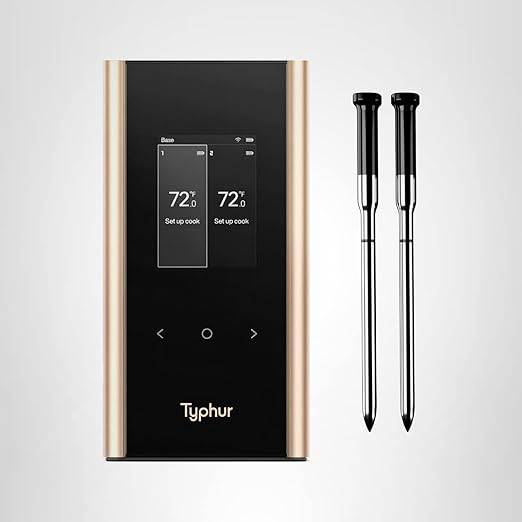

- Sync Gold WiFi meat thermometer: 6 sensors, 2 slim probes, ±0.5°F accuracy, 10x stronger Sub-1 GHz signal for reliable readings through grills, smokers, ovens and Kamado.
- Standalone smart base with direct setup and app remote control, lightning-fast 0.5s updates, IPX8 waterproof probes heatproof to 932°F – built for open flames and dishwasher safe.
- The Typhur Sync Gold receives strong, overall praise for reliable long‑range connectivity and fast, accurate readings — most reviewers call it a good value and praise the app/base combo.
- There are a handful of complaints — most notably occasional probe overheating or odd ambient readings — but these appear to be an isolated minority in the supplied review summary, not a widespread safety recall or brand‑level scandal.
- If you buy one: test it immediately (cross‑check with a known thermometer), keep evidence of any fault, and contact Typhur/Amazon quickly for replacement or refund if you see problems.
- Quick factual takeaways from the listing and supplied reviews: high‑precision probes, Sub‑1 GHz long range, standalone smart base, IPX8/dishwasher safe.
Product Overview
The product (trimmed title: Typhur Sync Gold Wireless WiFi Meat Thermometer (2 Probes, 6 Sensors)) is presented as a premium wireless cooking monitor built for backyard smokers, kamado grills, ovens and air fryers. Key hardware and software claims in the listing include probes that combine five internal sensors plus one tip ambient sensor (designed to improve stability and prediction), a dedicated base that can operate without a phone, and a companion app for remote monitoring and alerts. The manufacturer emphasizes professional features: ±0.5℉ accuracy, a 0.5‑second response time, and probes that are rated IPX8 and durable to 932°F for open‑flame and high‑heat cooking. Another headline technical claim is the use of Sub‑1 GHz radio for probe‑to‑base communication, which the listing markets as offering 10x stronger signal than typical Bluetooth sensors and therefore deeper penetration through walls and grills. The device also touts triple calibration during production, the ability to track multiple zones simultaneously, and dishwasher‑safe probes. In short: the Sync Gold positions itself as a rugged, high‑accuracy, long‑range thermometer system with both standalone and cloud‑connected convenience.
- Aggregated review counts show broad satisfaction (value, accuracy, ease of use, connectivity), with a minority of complaints focused on ambient/probe issues.
- Numbers from the supplied summary help quantify the pattern: most categories are 80–100% positive, while ambient/overheat mentions show higher relative negativity.
Typhur Sync Gold Wireless WiFi Meat Thermometer (2 Probes, 6 Sensors) Review: Honest Findings
Based on the supplied customer‑mention summary, the overall picture is solidly positive: large fractions of reviewers praise the unit’s value, usability, and wireless performance. For example, mentions of value (67 total) were 56 positive vs. 11 negative; functionality (51) was 45 positive vs. 6 negative; and accuracy (45) was reported 37 positive vs. 8 negative. Connectivity categories are overwhelmingly positive — “wireless connectivity” shows 26 positive and 0 negative mentions — supporting the listing’s claim about exceptional range. Put another way, the reviewers summarized in the dataset are mostly positive reviews across the core attributes buyers care about: accuracy, range, app usability, and build quality.
That said, the single area that stands out as disproportionately represented among negatives is ambient/overheating readings. The aggregated “ambient temperature” row includes 23 mentions: 16 positive and 7 negative. Those negative entries describe probe overheating or alarms — small in absolute terms but large enough to be noticed. So the headline finding is a dual one: the product gets broad praise for connectivity and accuracy, yet there exist isolated overheating reports and a handful of accuracy or connection glitches that buyers should be aware of and test for.
- Customers repeatedly praise the wireless range, app/base convenience, accuracy, and build quality.
- Several reviewers explicitly said they replaced other brands and found Sync Gold superior for real‑world cooks.
Positive Feedback & Highlights
Positive elements come through clearly in the supplied review snippets. The strong points most often mentioned are range and connectivity (monitoring “from inside the house” or even “from far away”), quick and intuitive setup, and dependable temperature reporting. Multiple customers called out flawless WiFi and Bluetooth operation and praised the device’s ability to maintain connection through smokers and kamado grills — the type of environment where weaker Bluetooth-only probes sometimes fail. The companion app and the standalone smart base are both cited as helpful: the base lets you set targets and view temps without your phone, while the app permits remote alerts and even Apple Watch notifications for certain users.
Accuracy and response time are another major selling point: reviewers repeatedly mention precise internal temps and consistent ambient measurements. The factory claim of professional‑grade precision (±0.5℉ and 0.5‑second response) is supported by multiple user statements like “accurate temps and constructed well” and “easy to use, accurate, takes the guess work out of how long to cook.” Customers also value the physical build — probes described as “heavy” and made to withstand a lot of heat — plus the dishwasher‑safe convenience. Taken together, the positives suggest a well‑engineered product that meets or exceeds buyer expectations for long cooks and remote monitoring.
- The most common negative pattern is probe/ambient overheating or alarms; a small number of users also reported accuracy or connection glitches.
- There is no sign in the provided review summary of a widespread scam, recall, or pervasive safety failure — the negatives appear limited to individual units or edge cases.
Negative Reviews & Rumor Analysis
Negative mentions exist but are concentrated and limited. The main cluster is reports of probe overheating (or alarming/erratic ambient readings), plus a handful of complaints about accuracy or functionality. That pattern raises two questions: (1) how frequent/severe are these complaints, and (2) do they indicate a systemic safety problem or a small number of defective units and/or user errors? Based on the supplied data, the balance of evidence points toward the latter — a small minority of users experienced trouble rather than a broad defect affecting most units.
Overheating reports — what reviewers described and plausible causes
The examples in the summary include statements like an alarm for overheating at a relatively low reported number (one customer described an alarm at “about 188 degrees” that triggered a loud overheating notice). That kind of report is concerning on its face, because 188°F is well below the stated extreme rating of the probes; however, several plausible explanations exist: a misconfigured alarm threshold in the app, a false ambient‑sensor reading, a probe defect, or placement too close to an extreme localized heat source (for instance, direct flame or metal contact that conducts heat into the probe sheath). Review snippets alone don’t prove a manufacturing catastrophe — they suggest isolated faults or setup/user issues. If you experience the same behavior, stop using that probe immediately, document the readings and behavior, and contact support or return the unit.
Accuracy and calibration concerns — how real are they?
The product’s marketing promises “triple‑calibrated” probes and ±0.5℉ accuracy. Most reviewers corroborate that accuracy in real cooks; however, there are a small number of accuracy complaints (8 negative accuracy mentions in the summary). In practice, minor deviation can arise from probe placement (hitting bone or fat), user confusion between internal vs. ambient sensors, or a single defective probe. Before concluding a unit is bad, good practice is to verify with a secondary trusted thermometer or perform simple checks (ice‑water test, boiling‑water check taking local boiling point into account). If an offset persists, reach out to Typhur for replacement — the triple‑calibration claim suggests the company expects to handle outliers.
Connectivity and app issues — mostly positive but not flawless
Connectivity is one of the device’s strongest selling points in the reviews, yet a few users (a small number relative to positive counts) described syncing or app problems. Typical causes for any wireless device include local Wi‑Fi reliability, placement of the base unit, firmware mismatches, or app permission settings on phones. Troubleshooting steps that solve the majority of reported problems are: ensure the base is near adequate network signal during initial setup, update the app and device firmware, give the app the necessary OS permissions, and reboot the base/phone if needed. If connectivity refuses to stabilize, contact support for deeper diagnostics or replacement.
Rumor check: recalls, safety scandals, or scams?
The supplied review text and aggregated mentions do not show any rumor pattern implying fraud, malicious behavior, or a formal recall. Reviewers explicitly praised the company’s support in at least one quote (“comes backed by a team that truly cares”), and no mass‑scale condemnation or safety recall language appears in the set. That doesn’t guarantee no problems exist beyond the supplied data, but within the dataset provided there is no evidence of a widespread recall or scam; the negative reports look like isolated hardware or configuration issues rather than a product‑line crisis.
- Best fit: backyard smokers, kamado owners, and cooks who want accurate remote monitoring from inside the house or farther away.
- Not ideal for buyers who need more than two probes in a single base, or who want zero chance of any hardware defect; always plan to test early and keep the return window in mind.
Who Should Consider Typhur Sync Gold Wireless WiFi Meat Thermometer (2 Probes, 6 Sensors)?
The Sync Gold is well suited to enthusiasts and semi‑pros: people who run multi‑hour smoke sessions, use kamado grills or pellet smokers that block Bluetooth, or want a hybrid workflow (standalone base + smartphone alerts). If you value long‑range monitoring and a robust physical base that can operate without a phone, this system is an attractive choice. The multi‑sensor probe design and the listing’s accuracy claim also make it appealing for cooks who want repeatable, measurable results rather than guesswork.
Conversely, it’s less compelling if you absolutely need four or six simultaneous probes in one kit (some reviewers explicitly wished they had purchased a 4‑probe version) or if you require absolute zero tolerance for any hardware hiccup (no electronics product offers that). Budget buyers who prefer the lowest possible purchase price may also consider simpler Bluetooth models, accepting shorter range and fewer features.
- Overall recommendation: strong positive endorsement for performance and range, with the caveat to verify your unit on receipt and be ready to contact support if anomalies appear.
- Practical buyer steps: initial tests, firmware/app updates, and documented returns if a probe behaves erratically.
Conclusion: Final Verdict
In the supplied review summary the Typhur Sync Gold thermometer emerges as a recommended with caution product: it delivers excellent wireless range, a useful smart base + app experience, and repeatable accuracy for most users, but a small number of customers reported probe overheating or odd ambient readings. Those complaints are real and worth taking seriously, but they do not, in the available data, amount to a systemic product failure or a brand‑level scandal. The sensible buyer approach is to accept the strengths while protecting yourself against the small risk of a defective unit: test the device immediately, cross‑check at least once with a trusted thermometer, and keep return documentation handy so you can resolve any problem quickly.
Action checklist for buyers
- Run a short test cook as soon as your Sync Gold arrives; verify internal readings against a secondary thermometer and check ambient readings inside the smoker/oven.
- If you see erratic or overheating alarms: stop using the suspect probe, take photos/screenshots, update firmware/app, and contact Typhur support or request a return through Amazon.
- For normal operation, maintain good probe technique (proper insertion, avoid contact with bone or direct flame) and position the base sensibly during long cooks for best connectivity.
Bottom line: the product’s feature set and the majority of customer feedback make it a compelling pick for serious home cooks and backyard pitmasters. The small cluster of probe‑related complaints deserves attention, but the supplied evidence points to isolated faults rather than a broad product‑line safety problem. If you buy one and follow the short validation steps above, you’ll maximize the odds of a satisfying long‑term experience.
- Sync Gold WiFi meat thermometer: 6 sensors, 2 slim probes, ±0.5°F accuracy, 10x stronger Sub-1 GHz signal for reliable readings through grills, smokers, ovens and Kamado.
- Standalone smart base with direct setup and app remote control, lightning-fast 0.5s updates, IPX8 waterproof probes heatproof to 932°F – built for open flames and dishwasher safe.

Comments