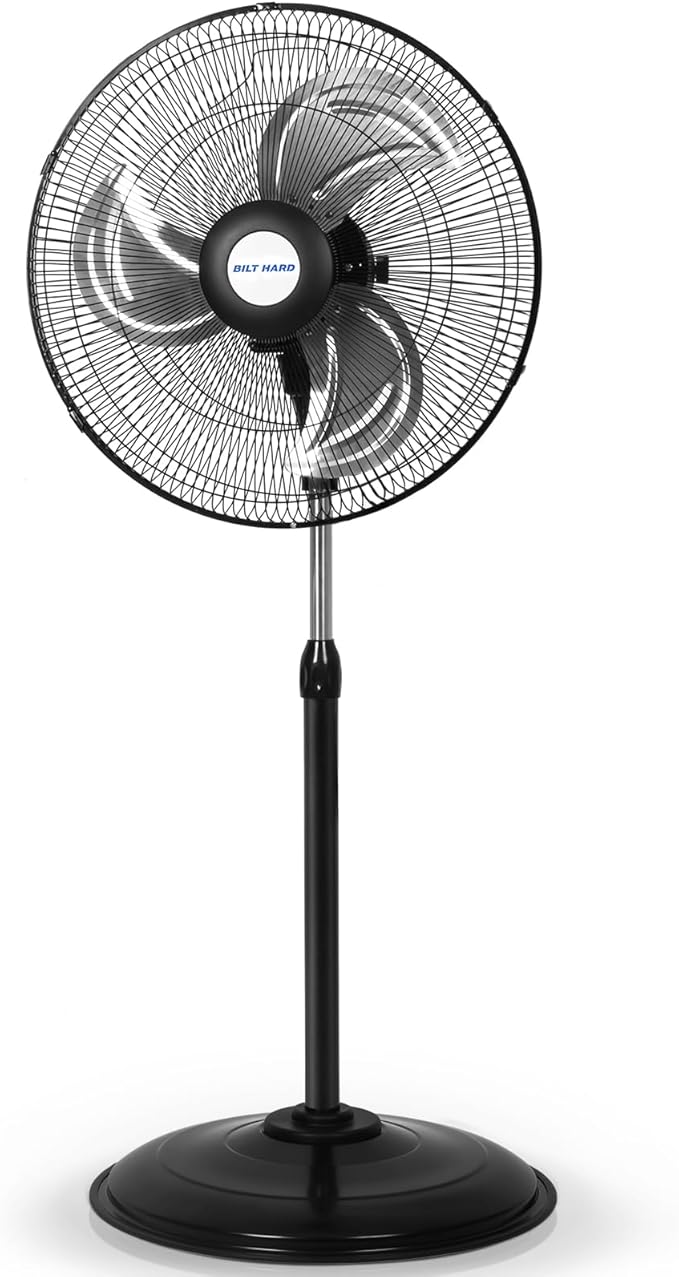
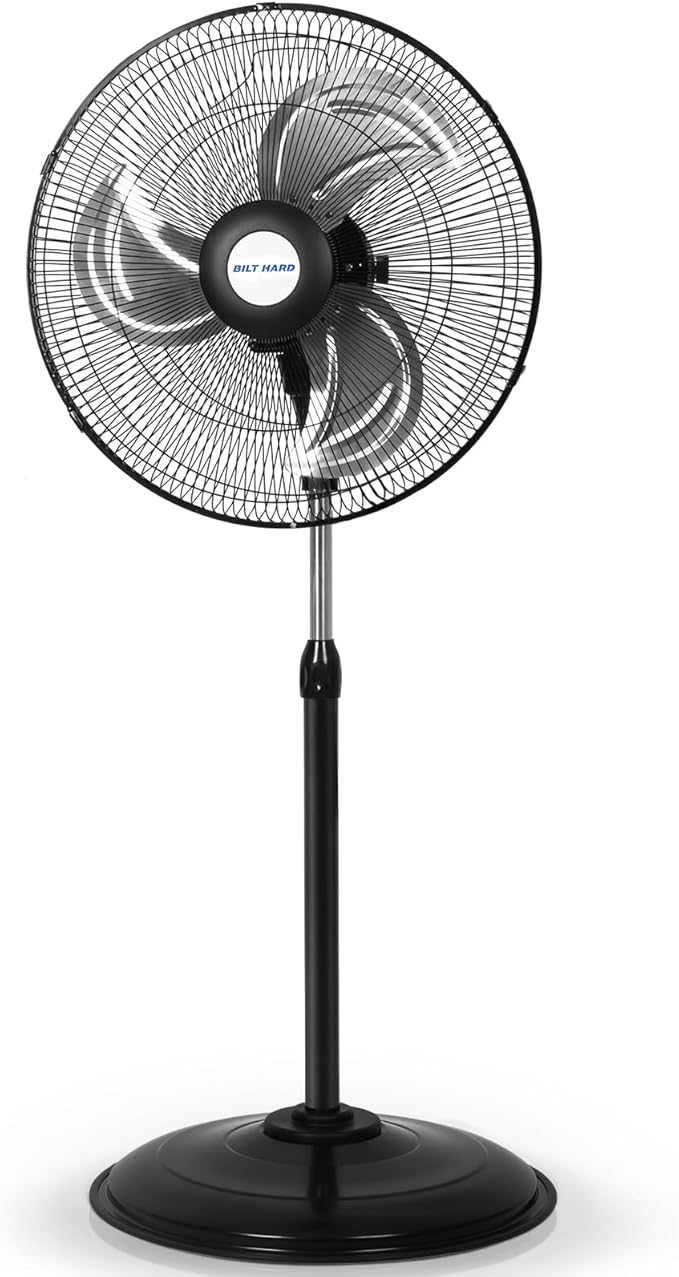
BILT HARD 3900 CFM 18″ High Velocity Pedestal Oscillating Fan, 3-Speed Heavy Duty Metal Standing Shop Fan with Aluminum Blades for Commercial, Residential, and Garage, UL Listed
- 18-inch high-velocity pedestal fan – up to 3900 CFM, 3 speeds, adjustable 43.7-52.4 in height and oscillation. Heavy-duty metal with balanced aluminum blades.
- Thermally protected PSC motor with UL-listed safety, 6 ft cord and small-grid guard. Easy assembly, wide base and 1-year warranty. Dependable heavy-duty cooling for workshops and garages.
- Powerful, industrial-grade airflow is the product’s strongest attribute — most reviewers praise the air movement and motor power.
- The most consistent downsides are noise and occasional stability/tilt problems; a small number report early failures but the unit is UL listed and backed by a 1‑year warranty.
- For garages, workshops, patios and other noisy or open spaces this fan is a strong pick; it’s less suited to bedrooms or noise‑sensitive indoor use.
- Many negative issues are fixable or covered by warranty — inspect and test immediately, tighten hardware, and contact the manufacturer for exchanges when needed.
- Core facts: industrial motor, 3900 CFM, aluminum blades, metal body, UL listed, adjustable height.
- BILT HARD 18″ High‑Velocity Pedestal Oscillating Fan — Product Overview — 3900 CFM industrial airflow
- BILT HARD 18″ Fan Review: Honest Findings — what customers actually say
- Positive Feedback & Highlights — why people like this fan
- Negative Reviews & Rumor Analysis — noise, stability, and isolated failures
- Who Should Consider the BILT HARD 18″ Fan? — best fit and who should avoid it
- Conclusion: Final Verdict — powerful but not for quiet rooms
BILT HARD 18″ High‑Velocity Pedestal Oscillating Fan — Product Overview — 3900 CFM industrial airflow
The BILT HARD 18″ High Velocity Pedestal Oscillating Fan is positioned as an industrial / heavy‑duty standing fan suited to garages, workshops, patios and larger rooms. According to the product information, it offers an adjustable height (43.70″–52.36″), three speed settings, a thermally protected PSC motor rated up to 3900 CFM at 1430 RPM, and individually balanced aluminum blades housed in a metal guard. The fan includes a wide metal base, a 6‑foot cord with a UL 3‑pin plug, small grid spacing on the guard to reduce finger access, and a 1‑year manufacturer warranty with direct customer service and free exchanges for quality issues.
Practical takeaway: this is built to move a lot of air and to survive tougher environments than typical plastic household fans. That design emphasis — metal blades and a high‑output motor — drives its strengths (airflow, durability in shop settings) and also explains the main tradeoffs (noise and a heavier head that can affect balance).
- The overall customer sentiment favors power and value, but there are recurring functional complaints.
BILT HARD 18″ Fan Review: Honest Findings — what customers actually say
Summarizing the review clusters provided gives a clear picture: the fan’s strongest metrics are airflow and power, while noise and stability are the most frequent negatives. For example, “Airflow” appears in 103 customer mentions with 96 positive and 7 negative mentions (~93.2% positive). “Fan power” shows 99 mentions with 89 positive vs 10 negative (~89.9% positive). “Build quality” is generally favorable (63 positive / 82 total mentions ≈ 76.8% positive), and “ease of assembly” is mostly positive (40/54 ≈ 74.1% positive). On the flip side, “noise level” appears in 71 mentions where 41 of those are negative (≈57.7% negative about noise), “oscillation” is mixed (31 mentions split roughly 15 positive / 16 negative), and “fan stability” is notable: 19 mentions and all 19 are complaints about tilting or instability.
What this means in plain language: most buyers get what they expect — a very powerful shop fan that moves a lot of air for a fair price — but a consistent minority experience problems (primarily loud operation, wobble/tilt, or early defects). The sample sizes suggest these issues are significant enough to be noticed by many buyers, though not necessarily universal for every unit.
- Clear strengths: airflow, power, build feel and perceived value by most buyers.
Positive Feedback & Highlights — why people like this fan
The most cited positives revolve around raw performance and perceived value. Customers often say the fan “moves a lot of air” on all three speeds and that even the low speed outperforms typical household fans with plastic housings. Multiple reviewers highlight the heavy‑duty motor, the solid metal base, and the balanced aluminum blades as contributors to effective airflow and durability. The fan’s industrial look and lower price relative to similar heavy‑duty models also drive comments that it represents good value for money.
Common real‑world uses reported by buyers include cooling garages, workshops, back patios and even sleeping with the unit in a bedroom for people tolerant of louder fans. Ease of assembly is another frequent plus — many buyers report straightforward setup with just basic tools. The UL 3‑pin plug and the claimed thermal protection on the motor are also cited by some buyers as comfort factors for a shop environment.
- Primary negatives: loud operation for some users, and mechanical stability/tilt problems reported repeatedly.
Negative Reviews & Rumor Analysis — noise, stability, and isolated failures
The negative feedback can be grouped into a few recurring themes. The most frequent complaint is noise: 71 customers mentioned noise, and more reviewers found it too loud than acceptable (41 negative vs 30 positive). Descriptions range from “not a quiet fan” to colorful comparisons like “sounds like a plane engine” at higher speeds. This pattern is consistent with metal blades and a high‑output motor: industrial fans trade acoustic quietness for performance. If you need whisper‑quiet operation the design is not optimized for that.
Noise: how bad is it?
Expect a sound profile typical of a metal‑bladed high‑velocity fan: strong whoosh and motor hum on low, loud sweep and higher motor tone on medium and high. Some customers can use it for sleeping on low; others find even low intrusive. Because noise tolerance is subjective, reviews reflect that variance: roughly 42% of reviewers who mentioned noise found it acceptable, but a majority reported it as too loud. If quieter performance is crucial, consider fans designed specifically for low decibel output (typically with larger diameter, plastic blades and slower RPM).
Stability and oscillation issues
Stability is the second clear cluster of complaints. Nineteen mentions focus on instability or a tendency for the head to tilt backward; all those mentions were negative. Several reviewers describe a loose tilt mechanism or a heavy motor head that causes the fan to “flop back” unless regularly re‑adjusted. Oscillation receives mixed reviews: some praise the electrically controlled oscillation (as opposed to a mechanical post), while others report wobble or uneven oscillation that can contribute to the perceived instability.
Likely root causes (based on descriptions): the heavy metal motor and blade assembly raises the center of gravity of the fan head, and if the tilt clamp or bolt is not sufficiently tightened or was assembled loosely at the factory, the head can settle back. The oscillation motor or the way the cage attaches can amplify minor misalignments into a noticeable wobble. These are plausible mechanical wear/tolerance issues rather than a single catastrophic defect, but they are common enough to be an important consideration.
Early failures and “only worked a few days” reports
A small number of reviewers report units that failed quickly — for example, comments that the fan “only worked for a couple of days.” The provided review summary does not indicate large numbers for premature failure, but the existence of any early failure reports is worth noting. Fortunately, the product includes a 1‑year manufacturer warranty and direct customer service with free exchanges for quality issues, which is the practical recourse for early defects.
Rumors and safety concerns
Among the available review data there is no organized pattern suggesting a systemic safety hazard (e.g., motor fires, structural collapse, blade separation) — the dominant quality concerns center on noise, wobble/tilt and occasional early stoppage. The product description highlights small grid spacing to reduce accidental finger injuries and a UL listing plus a thermally protected PSC motor, which are positive safety indicators. If you see alarming rumors (social posts claiming dangerous failures), weigh them against the aggregated review trends: isolated complaints appear present, but widespread catastrophic issues are not evident from this dataset.
Practical fixes & what to do if you buy one
Many negative issues are addressable without returning the unit. Practical steps to mitigate common complaints include:
- Tighten the tilt bolt and all base/head fasteners after assembly; add a washer or lock nut if necessary to reduce head drift.
- Place the fan on a firm, level surface and confirm base screws are snug; use anti‑vibration pads if floor resonance amplifies noise.
- Run the fan at low speed first to verify oscillation and balance before mounting it where you plan to use it long‑term.
- If you encounter early failure or persistent instability/wobble, contact the manufacturer for an exchange under the 1‑year warranty — reviewers report manufacturer exchanges are available for quality issues.
These straightforward adjustments will solve many tilt and wobble complaints; true motor failures or noisy bearings should be handled by warranty support.
- Best use cases: noisy or open spaces where raw airflow matters more than quiet operation.
Who Should Consider the BILT HARD 18″ Fan? — best fit and who should avoid it
This fan is well matched to people whose primary needs are strong airflow for large or open spaces and a rugged metal construction that stands up to shop and garage environments. Ideal buyers include homeowners with hot garages, small shops and hobbyists who need quick circulation, and anyone looking for a budget‑friendly, industrial‑style fan for outdoor or semi‑outdoor areas.
Conversely, the fan is less suitable for buyers who need a quiet appliance for bedrooms, nurseries, or small, noise‑sensitive rooms. If you prioritize whisper‑quiet operation and precise, wobble‑free oscillation for indoor living spaces, look at purpose‑built indoor fans that trade maximum CFM for quieter blades and refined mounts.
Quick pre‑purchase checklist:
- Decide if noise vs airflow tradeoffs are acceptable.
- Plan to inspect and test the unit on arrival (tighten tilt hardware, run all speeds, test oscillation).
- Keep your receipt and understand the 1‑year warranty policy so you can pursue an exchange if you receive a defective unit.
- Overall: strong performer with tradeoffs; manageable risk if you test on arrival and use the warranty when necessary.
Conclusion: Final Verdict — powerful but not for quiet rooms
The BILT HARD 18″ High Velocity Pedestal Oscillating Fan delivers on its central promise: it moves a lot of air and is perceived as a good value by most buyers. The heavy‑duty motor and metal blades produce the high CFM that workshops, garages, patios and similar spaces need. However, that same design leads to legitimate tradeoffs: many users report louder operation than household fans and a recurring set of complaints around tilt, wobble and occasional early failures.
My practical conclusion based on the provided review data:
- If you want an affordable industrial fan to cool large or open spaces and you accept some noise and the need for a little mechanical tuning, this is a strong candidate.
- If you need a quiet, perfectly stable fan for a bedroom or nursery, consider quieter, purpose‑built indoor models instead.
- When you buy: inspect and test immediately, tighten hardware, and use the 1‑year warranty promptly if you encounter early failure or a persistent mechanical defect.
In short: good performance with predictable tradeoffs. There is no clear evidence in these reviews of a widespread safety scandal or a systemic manufacturing catastrophe — the issues are mostly usability and occasional defects that the warranty is positioned to address.
BILT HARD 3900 CFM 18″ High Velocity Pedestal Oscillating Fan, 3-Speed Heavy Duty Metal Standing Shop Fan with Aluminum Blades for Commercial, Residential, and Garage, UL Listed
- 18-inch high-velocity pedestal fan – up to 3900 CFM, 3 speeds, adjustable 43.7-52.4 in height and oscillation. Heavy-duty metal with balanced aluminum blades.
- Thermally protected PSC motor with UL-listed safety, 6 ft cord and small-grid guard. Easy assembly, wide base and 1-year warranty. Dependable heavy-duty cooling for workshops and garages.
Comments