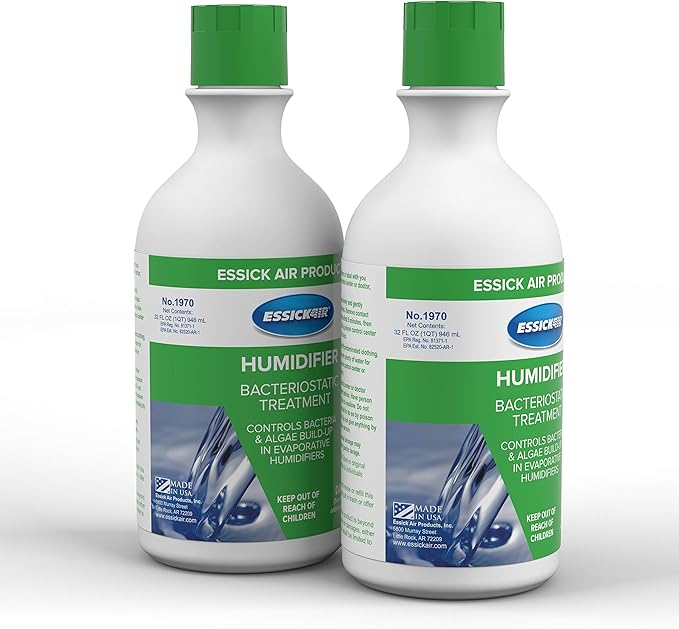

1970-2 Humidifier, 2-Quart Bacteriostatic Treatment, 2 Pack (1970-2)
- 2-pack bacteriostatic humidifier treatment: two 32 oz (2-quart) bottles help inhibit bacterial growth, keep water fresher longer, and maintain humidifier performance.
- Convenient 2-pack refill supply: each 32 oz bottle delivers bacteriostatic protection for longer, cleaner operation, ideal for home, office, or nursery humidifiers.
- Effective at its core: Most reviewers report the treatment reliably prevents bacterial and mold growth in humidifiers.
- Safety warnings are notable: Multiple reviews quote label language and describe a concentrated solution that warrants careful handling, especially around children and pets.
- Smell is inconsistent: Some users report no odor while others detect a chemical scent — this appears dose- and unit-dependent.
- Good value and ease of use: Many customers say the 2-pack is inexpensive, extends wick life, and reduces cleaning frequency.
- No clear evidence of recalls or mass harm in the supplied reviews, but the dataset contains multiple safety-related complaints and label-alert quotes that merit caution and verification.
- What this section shows: concise product basics and how reviewers describe the item.
Product Overview
The listing under review is a humidifier treatment sold as a 2-pack of gallon-equivalent containers (listed as 2 – 32 Ounce Bottles, i.e., a total of two quarts). It is described and discussed by customers as a bacteriostatic solution intended to slow or prevent bacterial and algal growth in humidifier reservoirs and on wicks. Based on the review excerpts provided, the product’s main consumer promise is straightforward: add the measured dose to the humidifier water to reduce biofilm build-up, extend wick life, and keep vaporized moisture cleaner.
The review dataset emphasizes use with wick-style and whole-house humidifiers; phrases from customers include that it “works great in a wick style humidifier” and that it “prevents bacterial growth and keeps the air clean.” Quantitative cues from the supplied reviews show high counts for functionality and bacteria defense mentions — suggesting that the product is used for the intended purpose and that many users see a measurable benefit.
- Key findings: aggregate sentiment, main praise and concerns from reviewers.
1970-2 Bacteriostatic Humidifier Treatment (2 x 32 oz) Review: Honest Findings
In the supplied review summary the strongest themes are effectiveness and safety concerns. Functionality is the most commonly mentioned topic: 249 customers referenced function, with 243 positive and only 6 negative mentions — a clear signal that the product typically performs as advertised. Likewise, all 87 mentions grouped under “Bacteria defense” were positive in the summary, indicating consistent user experiences that the treatment inhibits microbial film and preserves wick life.
At the same time, smell and safety are recurring flags. Ninety-five customers mention smell (60 positive vs. 35 negative), revealing a divided perception: while many customers say the product is effectively odorless, a substantial minority perceives a chemical odor. More critically, safety is a frequent subject — 69 customers referenced safety, with 56 of those mentions negative. Negative safety comments reference label warnings, concentration, and the phrase “HARMFUL TO HUMANS AND ANIMALS” as quoted by reviewers. That ratio means safety is the principal area where reviewers disagree or express concern, even if most functionality-related reports are positive.
Summary interpretation: the supplied reviews portray a product that generally does its job — controls bacteria and reduces maintenance — but that generates a meaningful number of safety-related comments that buyers should heed. There are no provided review excerpts that document confirmed poisoning events or wide-scale incidents, but repeated label warnings and user cautionary notes are enough to treat safety as a primary factor when deciding to buy.
- Highlights: what users like most and why buyers cite value and convenience.
Positive Feedback & Highlights
The positive consensus centers on three tightly related practical benefits: bacteria prevention, reduced cleaning frequency, and cost-effectiveness. Customers repeatedly report that the treatment keeps reservoirs and internal humidifier parts free of the slime and biofilm that typically accumulate during use. Typical praise includes lines like “Does the job in preventing bacteria build up” and “Keeps the water and filter fresh for a longer period,” which supports the product’s purpose as a bacteriostatic additive.
Value for money is another common theme. Roughly 82 customers mentioned value, and most of those mentions were positive; phrases include “relativeley inexpensive” and “a bottle should last at least one heating season.” For many buyers the cost-to-benefit ratio is attractive: a small measured dose per fill equates to low per-use cost and less frequent wick replacement — two economic advantages for people who run humidifiers through an entire dry season.
Ease of use is also cited frequently: 60 customers mentioned usability, with 49 positive comments. Users describe the treatment as “easy to use” and “easy to install”; for many the simplicity of adding a dose when refilling the tank is a decisive convenience. Several reviewers note that the product performs well across whole-house setups and smaller wick humidifiers, which increases its practical appeal.
- Main concerns: smell variability and safety-related language in reviews.
Negative Reviews & Rumor Analysis
Negative feedback clusters around two overlapping issues: odor and safety warnings. Smell is a mixed but non-trivial complaint — 35 of 95 smell mentions were negative — and safety alarms are significant because they often quote or react to the product label. A representative reviewer wrote that the product is “listed as ‘HARMFUL TO HUMANS AND ANIMALS,'” which understandably alarms buyers even when used as directed.
Smell: Mixed reports and likely causes
Smell reports span “no detectable odor” to “strong chemical odor.” That inconsistency can have several non-exclusive explanations:
- Dose variance: over-concentration by accidental overdosing can amplify any solvent or preservative scent present in the formula.
- Interaction with hard water or mineral deposits in the humidifier can produce off-odors as product residues react or concentrate on wicks.
- Different humidifier mechanics (e.g., ultrasonic vs wick evaporative systems) may change how residual chemicals are aerosolized and perceived in the room.
The supplied reviews suggest that many users experience little to no odor when they follow instructions; others report a “slight” or “off-putting” scent. From the dataset it’s reasonable to conclude smell sensitivity varies by user and usage, and small adjustments (use less product, flush tank, change wick) are likely to change outcomes.
Safety: label language and how to interpret it
Safety commentary is the most serious area raised in the reviews. Comments include warnings that the solution is “very concentrated” and “definitely harmful if excessive amounts are used,” along with specific shock phrases like “HARMFUL TO HUMANS AND ANIMALS.” That wording appears to come directly from product labeling as relayed by reviewers and is not, by itself, proof of misuse or harm — it is a manufacturer or regulatory precautionary statement that should be respected.
Important nuance: label warnings commonly appear on concentrated chemical treatments and do not automatically mean routine, correct use will cause harm. Several reviewers explicitly noted that the product is “SAFE if you follow the instructions,” which is consistent with many household chemical products that carry strict handling language. However, the review pool contains a fair number of negative safety mentions (56 out of 69 safety mentions), which indicates that buyers are noticing the warnings and some find the instructions or measuring method inconvenient or borderline hazardous.
There are two practical takeaways from the safety chatter in the reviews:
- If you or household members are chemically sensitive, or if you have pets and young children, treat this product with extra caution and consider alternatives.
- Follow dosing instructions precisely, measure using secure tools, and avoid spillage or direct skin/eye contact; reviewers who reported problems often mentioned dosing or handling difficulties.
Rumor analysis: is the product ‘dangerous’ or ‘banned’?
Among consumer posts, “rumors” sometimes inflate label language into claims of systemic danger or recalls. In the set you provided there are no explicit review excerpts claiming regulatory action, recalls, or verified poisoning incidents tied to this product. The stronger pattern is that the label — and some reviewers’ interpretation of it — raised alarm among users. So, based on the supplied content, the label language is the primary origin of safety “rumors” rather than evidence of widespread harm. That said, the repeated vocal concerns in reviews are real and should be taken seriously by prospective buyers.
If you are evaluating this product and want to verify safety beyond what reviewers report, the proper steps are:
- Request or locate the product’s Safety Data Sheet (SDS/MSDS) from the manufacturer or the seller listing to identify the active ingredients and hazard statements.
- Confirm dosing instructions and whether the product is intended for continuous occupancy areas, or only for use in unoccupied or ventilated spaces during and immediately after fill-up.
- Contact the manufacturer with specific safety questions if the label language is alarming or unclear.
- Who benefits most from this product and who should be cautious or skip it.
Who Should Consider 1970-2 Bacteriostatic Humidifier Treatment (2 x 32 oz)?
This treatment looks best suited to people who run humidifiers frequently (season-long use) and want to reduce maintenance: those who use wick-style humidifiers, whole-house evaporative systems, or units that historically develop biofilm. Reviewers frequently note improved wick longevity and less frequent cleanings, which makes the product attractive to households that value low-maintenance humidification.
Conversely, exercise caution or choose a different approach if any of the following apply:
- You have very young children, unweaned infants, or pets that are prone to drinking or playing in humidifier reservoirs — the label warnings cited by reviewers suggest extra vigilance in such homes.
- Household members are chemically sensitive or have respiratory conditions aggravated by perceived odors; several reviewers reported a “strong chemical odor” under certain conditions.
- You prefer completely fragrance-free or additive-free humidification and would rather change wicks and clean tanks more often than introduce a chemical treatment.
For cautious buyers who still want microbial control: consider using a much smaller test dose to verify odor and effects in a single room before applying the product to a whole-house system. And again, follow instructions exactly and store the product securely out of reach of children and pets.
- Final assessment: balancing efficacy, safety comments, and buyer suitability.
Conclusion: Final Verdict
Based on the supplied reviews, the 1970-2 humidifier treatment appears to be an effective bacteriostatic additive that gives many users reduced maintenance, longer wick life, and reliable bacterial control. Quantitatively, functionality and bacteria-defense mentions were overwhelmingly positive in the dataset, and many buyers recommend the product for ordinary humidifier upkeep.
However, the product carries a clear safety and perception trade-off: label warnings and a non-trivial share of reviews reporting chemical odors mean that it is not universally comfortable for all households. The supplied reviews contain no documented mass-harm or recall information, but the repeated label-quoted phrase “HARMFUL TO HUMANS AND ANIMALS” and numerous safety complaints are sufficient reason to verify the Safety Data Sheet, follow dosing/handling instructions scrupulously, and consider alternatives if you have vulnerable occupants or pronounced odor sensitivity.
Final recommendation: if you want a cost-effective, bacteriostatic solution and can handle precise dosing and storage precautions, this product looks like a reasonable choice based on user experience. If safety label language or odor concerns are a high priority for you, request further safety documentation from the seller or choose an additive explicitly marketed as hypoallergenic/odor-free or opt for a mechanical cleaning regimen instead.
1970-2 Humidifier, 2-Quart Bacteriostatic Treatment, 2 Pack (1970-2)
- 2-pack bacteriostatic humidifier treatment: two 32 oz (2-quart) bottles help inhibit bacterial growth, keep water fresher longer, and maintain humidifier performance.
- Convenient 2-pack refill supply: each 32 oz bottle delivers bacteriostatic protection for longer, cleaner operation, ideal for home, office, or nursery humidifiers.
Comments