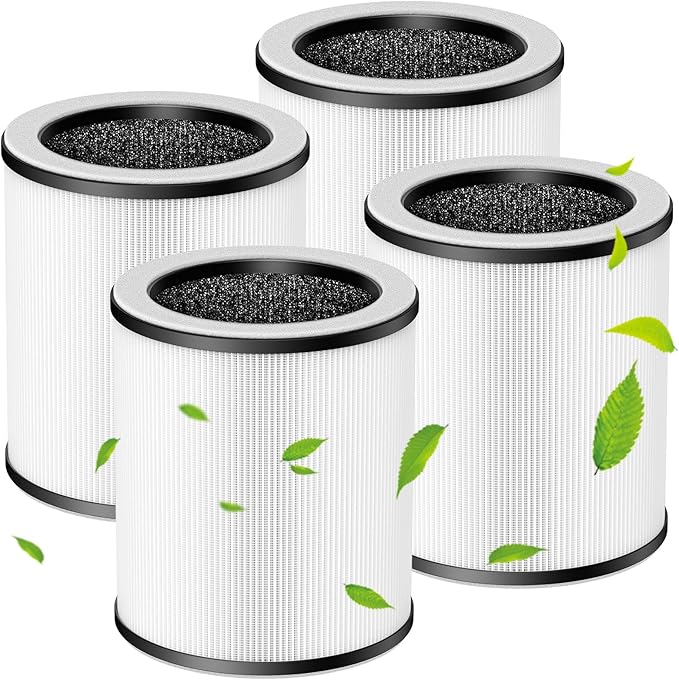

P60 Replacement Filters for TPLMB P60 Air Purifier, for Vhoiu KJ50 Air Purifier, for YARIKI P60 Air Purifiers, 3 Layer Filtration with Nylon Pre-Filter, H13 HEPA Filter & Carbon Filter, 4 Pack
- P60 3-layer replacement filters: nylon pre-filter, H13 true HEPA and activated carbon remove 99.97% of particles down to 0.01 microns for cleaner, fresher indoor air.
- 4-pack P60 filters for cost-effective replacement every 6-8 months. Captures smoke, pet dander, odors and VOCs to keep your home fresh and healthy.
- No major complaints found in the supplied data: customer feedback supplied with the listing shows consistent praise for fit, function and value; there are no repeated safety or performance complaints reported in that sample.
- One notable claim deserves scrutiny: the product description’s “99.97% down to 0.01 microns” statement is unusually aggressive for consumer H13 filters and should be verified if you need certified filtration performance.
- Compatibility is strict — the listing explicitly states the filters are for TPLMB P60, Vhoiu KJ50 and YARIKI P60 only. Confirm your model before buying.
- For routine home use (allergies, dust, pet dander, odors) the product appears to be a cost-effective replacement; for medical-grade or extreme wildfire protection, consider certified OEM or professional-grade filters.
- Compatible only with specified P60 models; sold as a 4-pack.
- 3-layer design: nylon pre-filter, H13 HEPA layer, activated carbon layer.
- Product Overview — P60 Replacement Filters (4-Pack)
- P60 Replacement Filters (4-Pack) Review: Honest Findings — Customer feedback snapshot
- Positive Feedback & Highlights — Fit, functionality & value
- Negative Reviews & Rumor Analysis — No serious complaints found
- Who Should Consider P60 Replacement Filters (4-Pack)? — Best‑fit users
- Conclusion: Final Verdict — Practical recommendation
Product Overview — P60 Replacement Filters (4-Pack)
The listing describes a third‑party replacement set labeled for a narrow set of purifiers: TPLMB P60, Vhoiu KJ50 and YARIKI P60. The package contains four filters and the manufacturer recommends changing each filter every 6–8 months depending on usage and environment. The advertised filtration stack is a 3-in-1 system — a nylon preliminary filter (to trap hair, lint and large particles), an H13-grade HEPA element for fine particulates, and an activated carbon layer to reduce odors and VOCs. The listing also highlights cost-effectiveness, a claim that the filter media uses lower-density structure technology for reduced pressure drop, and that the filter media includes FSC‑certified paper. Finally, the description states suitability for wildfire smoke and repeats the manufacturer/seller name (isinlive), together with a warranty/return invitation.
Important factual elements to carry forward: the product is a replacement (third‑party) filter shipped as a 4-pack, it lists specific compatible machine models only, and it includes both an H13 HEPA claim and activated carbon. Those are the pieces to match against your purifier and performance expectations before purchase.
- Customer review data supplied is predominately positive across fit, function and value.
- No negative counts appear in the supplied summary; the dataset is small and should be cross‑checked for broader context.
P60 Replacement Filters (4-Pack) Review: Honest Findings — Customer feedback snapshot
The condensed customer-review summary provided lists multiple positive datapoints: 13 customers mentioned “Fit” (all positive), 12 mentioned “Functionality” (all positive), five referenced “Durability” and “Value for money,” and three explicitly noted improved “Air cleanliness” (pollen, smoke, dust). Representative quotes include: “Fit my air purifier perfectly!… These filters are so durable, they filter out soooo much it’s shocking,” and “Fits perfects, looks exactly like OEM products. Works great!”
What this means in practice: the supplied reviews consistently emphasize a correct fit and effective particle capture for typical household contaminants. There are no repeated complaints or one‑off serious issues shown in this subset. That said, the summary appears to be a compact aggregation — verify the full Amazon review page for the total number of reviews, star distribution, and verified‑purchase labels to assess sample size and depth before drawing a firm conclusion.
- Fit and function are the strongest recurring positives in the supplied reviews.
- Customers repeatedly praise durability and perceived value.
Positive Feedback & Highlights — Fit, functionality & value
The extracted review details show clear, repeated praise for three practical points: accurate fit, reliable filtration for household dust/pet dander/pollen, and cost/value. Examples from the supplied snippets:
- Fit: “Fits perfect! When I took out the old one it didn’t look dirty. I tapped it and there was a lot of dust.”
- Functionality: “Easy to replace and do a better job than our more expensive model.”
- Durability/value: “They last a long time… great deal!”
- Air cleanliness: “Cleans all pollen and smoke.”
Those points line up with what matters for an economical replacement filter: a good mechanical fit (no gaps or twisting), pleat quality (consistent media area), and a carbon layer that appears to reduce odors in normal home settings. The 4‑pack format and the positive notes about longevity make this offering attractive for households looking to keep replacement costs low while maintaining routine indoor air quality.
Practically, positive user feedback about fit and function reduces the typical friction points third‑party buyers worry about: wrong dimensions, poor sealing foam or inferior pleat construction. In the supplied set there are multiple confirmations that these filters behave like OEM replacements — an important reassurance if your goal is straightforward, periodic maintenance.
- No serious or recurring complaints are present in the provided review data.
- However, a specific filtration claim in the listing calls for verification before relying on it for high‑risk situations.
Negative Reviews & Rumor Analysis — No serious complaints found
In the supplied summary there are essentially no negative review counts shown — the flagged categories (Fit, Functionality, Durability, Value, Air cleanliness) list only positive mentions. That strongly suggests the sample you provided contains no recurring reports of product failure, safety problems, or damaging rumors about the filters. Absence of negative comments in a compact dataset is not proof there are none anywhere, but it is a good starting indicator.
Still, there are a few specific issues buyers commonly flag for third‑party air filters that are worth reviewing and watching for. None of these are reported in your supplied data, but they are typical “serious” complaint types if they appear elsewhere:
- Compatibility & Fit Problems: Filters that are slightly off‑size, have poor gasket foam, or allow air bypass are the most common non‑safety complaints. The supplied reviews specifically praise fit, which mitigates that concern here.
- Misleading Filtration Claims: The listing asserts “These P60 true HEPA air filters can attach 99.97% of airborne particles down to 0.01 microns.” That particular claim is unusually aggressive for consumer H13 filters and could be marketing shorthand rather than a lab‑verified performance guarantee.
- Carbon Saturation & Odor Return: Activated carbon has finite adsorption capacity; heavy smoke or VOC environments can saturate the carbon quickly, reducing odor control and requiring earlier replacement.
- Motor Stress / Airflow Issues: If a replacement filter is denser than OEM or has higher pressure drop it can reduce airflow or make a purifier work harder. This can present as decreased performance or unusual noises — no such reports appear in the data you provided.
- Counterfeit or Misbranded Product Rumors: On large marketplaces, occasional reports surface about counterfeit or mislabeled filters. The supplied review excerpts explicitly say the items “look exactly like OEM products,” which is reassuring, but it’s still smart to verify seller authenticity and packaging for your purchase.
A short technical note on the filtration claim: consumer “true HEPA” is commonly quoted as 99.97% at 0.3 microns (US convention), while European H‑class ratings (EN 1822) place H13 at ≥99.95% for the most penetrating particle size (MPPS). The claim of 99.97% at 0.01 microns (10 nm) is atypical and would normally require independent lab certification to substantiate. Some filters do capture a subset of ultrafine particles via diffusion, but manufacturers who make such ultra‑fine claims should ideally provide test reports from reputable labs (TÜV, SGS, Intertek, etc.). If you require verified performance (e.g., for smoke inhalation protection or medical reasons), ask the seller for lab certificates rather than relying on marketing statements.
How to approach any rumor or isolated negative review you find elsewhere:
- Check whether complaints are about a single bad batch or a systemic issue. A few isolated late deliveries or damaged packages are not the same as repeated product failures.
- Look for documented evidence — photos, dates, verified purchase badges, and communication with the seller. Repeated, detailed reports from different buyers are more credible than a lone claim.
- Ask for certification documents if filtration claims are central to your purchase decision. Reputable sellers will share test evidence or point to recognized standards (EN 1822, ISO test reports, etc.).
- If you suspect a counterfeit, compare packaging/set markings to known OEM references and open an Amazon claim with photos and serial/lot numbers if they differ.
- Best for owners of the specified P60 models who want an affordable OEM‑like replacement.
- Not recommended as the primary option for users needing certified hospital‑grade filtration or guaranteed ultrafine particle capture without documentation.
Who Should Consider P60 Replacement Filters (4-Pack)? — Best‑fit users
These replacement filters are a sensible option if you match the product’s intended use case: you own one of the compatible purifiers (TPLMB P60, Vhoiu KJ50, or YARIKI P60), you want an economical 4‑pack to keep maintenance costs down, and your primary concerns are household dust, pet dander, pollen and household odors. The supplied customer feedback suggests everyday home use is where these filters shine — they fit, work, and provide good value.
Who should look elsewhere:
- Immunocompromised households or hospital settings: If you need certified, traceable filtration (for clinical protection), prefer filters with independent laboratory certificates and buy from manufacturers who can supply EN 1822 reports or equivalent.
- Extreme wildfire/industrial exposure: These filters may help for smoke and odors, but if you live in a heavily smoke‑impacted area consider purpose‑built high‑capacity carbon filters, HEPA systems with certified ratings, or additional measures (air‑sealing rooms, portable cleanrooms, NIOSH‑approved respirators when outside).
- Non‑compatible purifiers: Do not buy assuming universal fit. The listing warns not compatible with other brands/models; measure and verify before purchase.
Buying checklist for interested shoppers:
- Confirm your purifier model (exactly) against the listing: TPLMB P60, Vhoiu KJ50, YARIKI P60.
- Check dimensions, gasket foam and pleat pattern against your old filter on arrival.
- Inspect packaging for H13 markings and any test/certification references; if filtration performance beyond common household needs is crucial, request third‑party test reports.
- Keep the original packaging and proof of purchase for returns if fit or performance issues arise.
- Provided data shows no serious complaints or persistent rumors — a positive baseline.
- Verify the product’s aggressive filtration claim and confirm seller authenticity before relying on it for high‑risk uses.
Conclusion: Final Verdict — Practical recommendation
Based on the product description and the supplied customer review summary, there are no serious complaints or persistent rumors present in the dataset you shared. Buyers repeatedly note excellent fit, good filtration for typical household contaminants, durability and strong value — and the seller encourages contact for warranty issues. Those are solid signs for a third‑party replacement filter when cost and routine performance matter most.
At the same time, the listing’s specific particle‑size claim (“99.97% down to 0.01 microns”) is outside the common shorthand used by consumer HEPA filter marketing and should be treated as a marketing statement unless the seller supplies substantiating third‑party lab data. If you require a guaranteed, certified level of ultrafine particle capture (e.g., for medical reasons or severe industrial/wildfire exposure), seek filters with verifiable test reports and consider OEM or professional‑grade systems.
Final, practical steps:
- Confirm model compatibility (TPLMB P60 / Vhoiu KJ50 / YARIKI P60) before ordering.
- Inspect the first filter you receive: fit it, check airflow/noise, and confirm there are no strong chemical odors from the media.
- If you need documented HEPA performance, ask the seller for independent lab certificates (TÜV/SGS/Intertek) showing H13 performance and MPPS test results.
- Keep packaging and use Amazon’s return process if the filter appears misfit or defective.
In short: for most home users of the compatible P60 purifiers the product appears to be a reliable and economical replacement with no red flags in the supplied review set — but verify the aggressive ultrafine particle claim with documentation if you plan to rely on the filters for high‑risk filtration needs.
P60 Replacement Filters for TPLMB P60 Air Purifier, for Vhoiu KJ50 Air Purifier, for YARIKI P60 Air Purifiers, 3 Layer Filtration with Nylon Pre-Filter, H13 HEPA Filter & Carbon Filter, 4 Pack
- P60 3-layer replacement filters: nylon pre-filter, H13 true HEPA and activated carbon remove 99.97% of particles down to 0.01 microns for cleaner, fresher indoor air.
- 4-pack P60 filters for cost-effective replacement every 6-8 months. Captures smoke, pet dander, odors and VOCs to keep your home fresh and healthy.
Comments