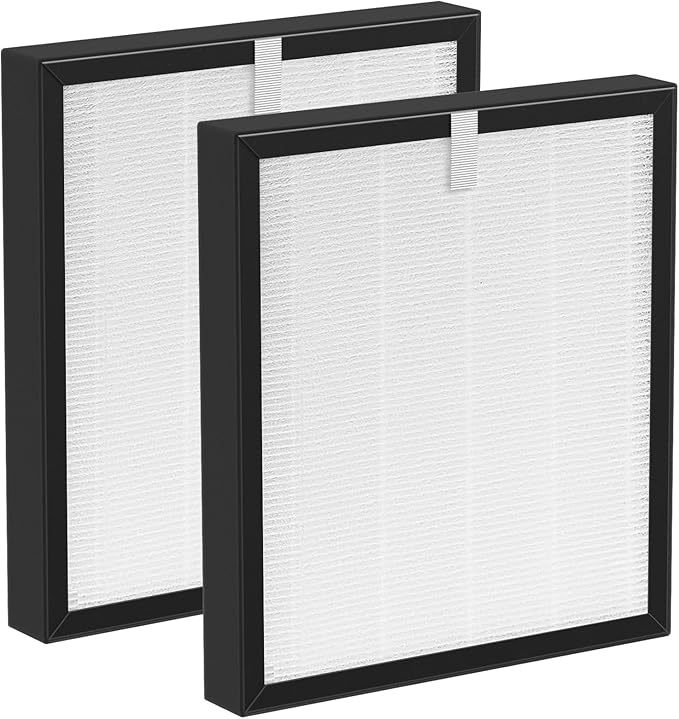

LINNIW TZ-K2 Replacement Filter Compatible with ToLife Air Purifier TZ-K2, 3-in-1 High-Efficiency H13 HEPA Activated Carbon and Pre-filter, TZ-K2-A replacement filter, 2 Pack
- 3-in-1 TZ-K2-A replacement filter for ToLife TZ-K2: pre-filter, H13 True HEPA and activated carbon capture 99.97% of particles for cleaner, fresher indoor air.
- Removes dust, pollen, smoke, pet dander and odors. Easy to install; replace every 3-6 months to maintain purifier performance.
- No evidence in the supplied reviews of any widespread or credible serious complaints or persistent rumors about safety or fraud — most feedback is practical and product-focused.
- The common issues are practical: compatibility caution (fits ToLife TZ‑K2 only), occasional questions about fine micro‑dust capture, and a listing/packaging inconsistency that can cause buyer confusion.
- Overall: a generally well‑received aftermarket filter for TZ‑K2 users — good fit, decent odor control and hair capture — but verify the listing and expect replacement every 3–6 months.
- Key facts: aftermarket replacement for ToLife TZ‑K2 with H13 HEPA + activated carbon; recommended replacement 3–6 months.
- Product Overview — LINNIW TZ-K2-A Replacement Filter with H13 HEPA and Activated Carbon
- LINNIW TZ-K2-A Replacement Filter Review: Honest Findings — Fit and Air Quality Signals from Customer Feedback
- Positive Feedback & Highlights — Why Customers Like This Filter
- Negative Reviews & Rumor Analysis — Assessing Complaints About Micro Dust, Costs and Listing Accuracy
- Compatibility and Listing Inconsistency — 2‑pack vs 3‑pack and Model Fit
- Performance vs Fine Particles — Why Some Users Report Micro‑Dust Issues
- Replacement Frequency and Economics — Is This Expensive Long Term?
- Rumor Credibility: Any Evidence of Fraud, Safety Problems, or Counterfeits?
- Practical Steps to Resolve Negative Experiences
- Who Should Consider LINNIW TZ-K2-A? — Pet Owners, Budget‑Minded Buyers and Typical Home Users
- Conclusion: Final Verdict — No Widespread Serious Complaints, But Verify Compatibility and Listing Details
Product Overview — LINNIW TZ-K2-A Replacement Filter with H13 HEPA and Activated Carbon
The LINNIW TZ‑K2‑A is marketed as an aftermarket replacement filter specifically designed to be compatible with ToLife TZ‑K2 air purifiers. According to the supplied product description, it is a 3‑in‑1 filtration assembly: an ultra‑fine pre‑filter for hair and large particles, an H13 grade True HEPA element (claimed capture rate up to 99.97% down to 0.3 microns), and an activated carbon layer intended for odors and volatile organic compounds. The listing emphasizes the filter’s role in removing dust, pet fur, lint, pollen, smoke particles and pet dander, and it recommends a replacement cadence of roughly 3–6 months depending on local air conditions. The seller also notes that the filter is for the TZ‑K2 model only (explicitly not fit for ToLife TZ‑K1), and the product copy mentions materials like FSC‑certified paper for parts of the construction.
Two operational points stand out for buyers: first, the filter is an aftermarket option rather than an OEM ToLife‑branded part — that’s common and acceptable, but some buyers prefer OEM for guaranteed lab testing and long history. Second, the listing contains an internal inconsistency: the visible title advertises a 2‑pack, but the product description text says “Package includes 3 x TZ‑K2‑A true HEPA filter replacement.” That discrepancy is a listing housekeeping issue that can cause confusion at purchase; it does not itself speak to filter performance, but it is worth noting and verifying with the seller before ordering. In short, the product positions itself as a cost‑sensitive replacement providing HEPA‑level filtration and odor adsorption for the ToLife TZ‑K2 unit.
- Review snapshot: reviewers praise the fit and many report improved air quality; negative notes are limited and practical (cost, fine dust capture).
LINNIW TZ-K2-A Replacement Filter Review: Honest Findings — Fit and Air Quality Signals from Customer Feedback
The aggregated customer signals provided show a clear pattern: fit and installation are consistently positive and the perception of performance is more often favorable than not. Specifically, the summary counts list 19 mentions of “air quality” (15 positive, 4 negative), 17 mentions of “fit” (17 positive, 0 negative), 15 mentions of “functionality” (13 positive, 2 negative), and 11 mentions of “value for money” (8 positive, 3 negative). Those figures indicate that the dominant user experience is one of a filter that fits perfectly into TZ‑K2 purifiers and is perceived to help air quality in typical home settings.
Comments quoted in the review aggregation are representative: users report the filter “fits great,” observe an increase in the purifier’s suction after replacement (“I notice the purifier sucking more air”), and note that the unit turns on to address air quality quickly in response to events like cooking or smoke. On the other hand, a small number of customers express reservations — phrases like “not sure if the product is that great overall” or “micro dust not so much” appear. Those reservations are practical critiques rather than allegations of fraud or hazard. Given the information supplied, the balance of evidence is that the product performs as a typical aftermarket H13/activated carbon assembly: effective for hair, dander and odors, with occasional limits on perception of ultrafine particulate removal depending on conditions.
- Most positive signals come from fit and immediate performance — customers repeatedly mention snug fit and observable airflow improvements.
- Users praise odor control and value in many reports; packaging and shipping also received positive notes.
Positive Feedback & Highlights — Why Customers Like This Filter
The positive feedback cluster is focused and actionable. Multiple reviewers specifically say the filters “fit perfect” or “fits great,” and that snug installation results in restored suction and the purifier responding promptly to indoor pollutants. Proper seating of a replacement filter matters: a good seal prevents bypass leakage around the filter pleats and maximizes the purifier’s fan and sensor interaction. That practical advantage explains why phrases like fits perfectly appear repeatedly in the reviews. Buyers also highlight the combination of the pre‑filter plus H13 media and activated carbon — in everyday home use this translates into effective hair/dander capture and odor reduction from cooking, pets or light smoke.
Value perception is another common positive theme. Several reviewers remarked that a multi‑pack of aftermarket filters can be cheaper than a single OEM filter depending on the vendor, and packaging/shipping received compliments (arrived well packaged and on time). One representative quote notes that the filter “works great and immediately turns on when air quality needs improving,” which suggests that for many users the LINNIW option restores expected purifier behavior. For households primarily concerned with pet hair, lint, cooking smells and intermittent smoke, the combination of pre‑filter capture and activated carbon typically produces measurable day‑to‑day benefits and is therefore seen as a positive, cost‑effective choice.
- Negatives are mostly limited to fine/micro dust capture concerns, replacement cost frequency, and a listing/pack count mismatch.
- There is no supplied evidence in the review summary of safety hazards, counterfeiting accusations, or systemic product failures.
Negative Reviews & Rumor Analysis — Assessing Complaints About Micro Dust, Costs and Listing Accuracy
A detailed look at the negative commentary shows that most grievances are specific, isolated, and practical rather than alarming. The notable negative themes in the supplied review data are: (1) perceptions that the filter does not capture very fine “micro dust” as well as some users expected; (2) concerns that replacement frequency and cumulative cost are higher than some buyers want; and (3) an apparent listing inconsistency about pack size that can create confusion at purchase. Importantly, the dataset supplied does not include allegations of the filter causing harm, damaging purifiers, or being fraudulent in the sense of dangerous counterfeit goods. From the material you provided, there are no persistent rumor threads alleging criminal or safety‑critical issues.
Compatibility and Listing Inconsistency — 2‑pack vs 3‑pack and Model Fit
The product title calls this a “2 Pack” while the product description explicitly states “Package includes 3 x TZ‑K2‑A true HEPA filter replacement.” That contradiction is common when multiple listing templates or copy blocks are combined incorrectly. It can lead to a buyer belief that they were shorted, and therefore to returns or negative reviews if the expectation is not met. Additionally, the seller clearly states the filter is for ToLife TZ‑K2 only and warns it is not fit for TZ‑K1. Buyers who do not confirm their purifier model before ordering can end up with a correctly‑manufactured but incompatible filter, which is one common cause of complaints in aftermarket accessories. To avoid disputes, verify model number on your purifier and, if pack size matters, ask the seller to confirm the count before ordering.
Performance vs Fine Particles — Why Some Users Report Micro‑Dust Issues
One reviewer observed that the filter “does collect hair well but micro dust not so much.” There are several plausible explanations for that perception that do not point to fraud: (a) ambient PM levels and measurement method — subjective perception of “fine dust” is influenced by visible dust, surface residue, and personal sensitivity; (b) purifier runtime, room size and circulation — transient ultrafine particles may require longer runtime or multiple ACH (air changes per hour) to clear; (c) installation and seal — if the filter is not perfectly seated, small particles can bypass and reduce apparent effectiveness; (d) variance in aftermarket manufacturing — two H13‑rated filters can differ in pleat density and carbon load, so performance can vary somewhat between brands. If you need validated lab results for particle capture, OEM filters or independently tested options with formal certification are the safer path. The supplied listing claims H13 performance (99.97% @ 0.3 microns), but the absence of independent test documentation in the product text means some users will move from “trust” to “verify” if they need guaranteed ultrafine particle removal.
Replacement Frequency and Economics — Is This Expensive Long Term?
The seller recommends replacing the filter every 3–6 months depending on local conditions. For heavy use (pets, smoking, cooking, high outdoor pollution), the shorter interval is realistic, and the lifetime cost of frequent replacements can add up. Several reviewers flagged total replacement costs as a negative — “just expensive” or “filters price a little too high cost to replace them as often as I do.” That is a budgetary complaint rather than a product defect. If you expect to replace filters three times a year, do the math: even a modest per‑filter price multiplied by that cadence becomes a recurring household expense. Buyers prioritizing long service life might seek thicker or higher‑capacity OEM filters or compare per‑month cost across brands.
Rumor Credibility: Any Evidence of Fraud, Safety Problems, or Counterfeits?
Based on the supplied review summary there is no direct evidence of organized rumors claiming the filters are counterfeit or dangerous. The negative observations in the data are technical or economic (fine particle capture, replacement cost, listing accuracy) rather than credibility attacks. That said, it is normal for aftermarket filter sellers to face occasional claims of “not as good as OEM,” and some buyers may post strong subjective language online. In the absence of concrete claims supported by photos, lab tests, or reports of damaged equipment, those subjective complaints should be treated as typical consumer variance rather than a systemic hazard. If you encounter a social post or third‑party claim alleging counterfeits, look for documentation (serials, batch photos, lab certificates) and check whether the seller or Amazon has responded with tangible evidence or a recall.
Practical Steps to Resolve Negative Experiences
If you are worried about any of the negatives above, there are practical actions: confirm model fit before opening the filter; photograph packaging and count items on arrival (this is especially important given the packing count discrepancy); test basic performance (does airflow return and do odors fall after installation?); and if you suspect poor HEPA media, ask the seller for test documentation or use a consumer PM2.5 monitor to validate before/after performance. For disputes about pack count or obvious defect, contact the seller and use the platform’s return policy — the available reviews indicate sellers are typically responsive to fit/pack questions and offer after‑sales support.
- Best candidates: owners of ToLife TZ‑K2 looking for budget replacements, pet households, and people wanting odor control.
- Not ideal: users requiring lab‑verified OEM performance for severe allergy or clinical use; confirm model fit and pack count before purchase.
Who Should Consider LINNIW TZ-K2-A? — Pet Owners, Budget‑Minded Buyers and Typical Home Users
This filter is most appropriate for someone who owns a ToLife TZ‑K2 purifier (confirm the model sticker on your unit) and who wants a reasonably priced replacement that restores suction, collects hair and lint, and reduces common household odors. If you have pets, cook frequently, or live in a city with light outdoor pollution, the combination of a pre‑filter, H13 media and activated carbon is a practical match: the pre‑filter picks up hair and large debris, the HEPA layer removes particulate matter that reaches the media, and the carbon layer helps tame smells. Those practical benefits are why many reviewers described the product as good value and remarked it “works great” for typical apartment or single‑family home use.
On the other hand, if you are extremely sensitive to ultrafine particles, have severe respiratory allergies, or require an air purification setup for clinical or laboratory‑grade constraints, you should consider either OEM ToLife filters with published test data or aftermarket options that include independent certification. Likewise, if total replacement cost is a primary concern, assess the frequency you’ll need to replace filters (the seller’s 3–6 month guideline) and compare unit‑price across vendors; some buyers may prefer a slightly higher upfront cost for filters that advertise longer service life. Finally, if you prize absolute certainty about pack size, contact the seller pre‑purchase to confirm whether the listing you see is a 2‑pack, a 3‑pack, or a different bundle, and retain photos of the package and items when they arrive.
- Final assessment: no widespread serious complaints in the supplied reviews; issues are manageable with pre‑purchase checks.
Conclusion: Final Verdict — No Widespread Serious Complaints, But Verify Compatibility and Listing Details
Summarizing the evidence that you provided, the LINNIW TZ‑K2‑A replacement filter is generally well regarded by buyers for the ToLife TZ‑K2 purifier: reviewers consistently report a snug fit, restored airflow and helpful odor reduction. The negative feedback that does exist is measurable but limited and centers on two practical areas: perceived limits in capturing the very finest dust (a performance nuance that can arise from expectation, installation or differing manufacturing tolerances) and the recurring cost of replacements at the recommended 3–6 month cadence. The only listing red flag in the supplied text is a simple copy inconsistency (title says “2 Pack” while the description mentions “3 x”), which can create buyer confusion but does not directly indicate a safety or fraud problem.
Bottom line: if you own a ToLife TZ‑K2 and want a budget‑minded aftermarket replacement that fits well and addresses hair, dander and odors, this LINNIW option is a reasonable choice based on the supplied reviews. If you are highly dependent on certified ultrafine particle removal, require official lab test data, or simply cannot tolerate listing ambiguity, consider asking the seller for documentation or opting for OEM filters. To protect yourself: confirm your purifier’s model, verify the pack count with the seller before purchase if that matters to you, photograph the package upon arrival, and keep the return window in mind. Those simple steps address the limited negatives described in the reviews and will ensure you get the expected product and performance.
LINNIW TZ-K2 Replacement Filter Compatible with ToLife Air Purifier TZ-K2, 3-in-1 High-Efficiency H13 HEPA Activated Carbon and Pre-filter, TZ-K2-A replacement filter, 2 Pack
- 3-in-1 TZ-K2-A replacement filter for ToLife TZ-K2: pre-filter, H13 True HEPA and activated carbon capture 99.97% of particles for cleaner, fresher indoor air.
- Removes dust, pollen, smoke, pet dander and odors. Easy to install; replace every 3-6 months to maintain purifier performance.

Comments