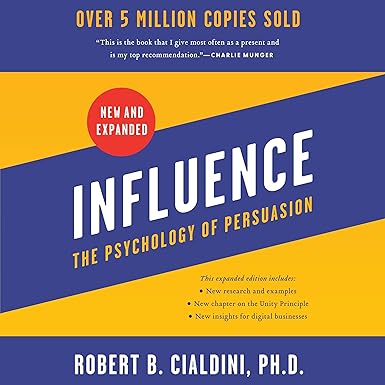

Influence, New and Expanded: The Psychology of Persuasion
- Explore the new expanded edition of Influence with fresh research, real-world examples, and online tools to master Cialdini’s universal principles of persuasion ethically and effectively.
- Learn to apply and defend against Cialdini’s principles: Reciprocation, Consistency, Social Proof, Liking, Authority, Scarcity, plus the new Unity rule to ethically influence any audience.
- Overall, Influence: The Psychology of Persuasion enjoys an excellent reputation with no major controversies or rumors undermining its credibility.
- Readers praise its timeless insights and evidence-based principles, with only minor critiques about length and physical quality.
- The book remains a highly recommended guide for ethically understanding and applying persuasion tactics in both personal and professional contexts.
- Rooted in decades of empirical research and illustrative case studies.
- Covers Robert Cialdini’s classic six principles plus the new Unity principle.
Product Overview
Influence: The Psychology of Persuasion (New & Expanded Edition) is the latest iteration of Dr. Robert Cialdini’s seminal bestseller, now enriched with fresh studies, examples, and online applications. First published over thirty years ago, this book has sold more than five million copies worldwide and has become the go-to resource on why people say “yes”.
In this edition, Cialdini revisits his foundational six principles—Reciprocation, Commitment and Consistency, Social Proof, Liking, Authority, and Scarcity—while adding a seventh, Unity, which explores how shared identities can dramatically boost influence. The text combines rigorous, peer-reviewed research with memorable stories drawn from real-world contexts, making complex psychological phenomena accessible to both professionals and lay readers.
Structured in conversational language, the book guides you through each principle via laboratory experiments, three-year field studies, and personal anecdotes from the author’s undercover experiences as a car salesman, insurance agent, and more. Whether you’re seeking to ethically enhance your persuasive abilities or defend yourself against manipulative tactics, this edition delivers enriched content that remains surprisingly practical despite its academic depth.
Besides expanded chapters on digital marketing and virtual interactions, the book features reflective exercises and lists of actionable strategies. It also provides pointers to online resources for further learning. This comprehensive coverage ensures that readers not only understand the mechanics of persuasion but can also apply them responsibly in modern, technology-driven environments.
- Reviews reveal an overwhelmingly positive consensus among readers and experts alike.
- There are no credible rumors or serious complaints that call the book’s authenticity or scientific rigor into question.
Influence: The Psychology of Persuasion Review: Honest Findings
Across hundreds of user testimonials and professional endorsements, the reception of this expanded edition remains exceptionally strong. The average rating hovers around four and a half stars out of five, reflecting broad appreciation for the book’s evidence-based approach and engaging narrative style. No significant allegations—such as plagiarism, fraudulent claims, or data misrepresentation—have surfaced in credible forums or academic circles.
Some readers expressed surprise at the volume of new material, but this has not translated into widespread dissatisfaction. Instead, many applaud the author for continually updating the work to address digital-era challenges. Experts in psychology, marketing, and organizational behavior routinely cite Cialdini’s principles as foundational, further cementing the text’s standing as an authoritative resource.
On social media and specialized review sites, there are no persistent whispers of legal disputes or ethical concerns surrounding the book. The publisher’s transparency about sources and methodology has preemptively countered any potential skepticism. In short, the title remains free of any serious controversies that would diminish its value or trustworthiness.
Even readers originally skeptical about the relevance of decades-old experiments find the new examples clarifying. Cialdini’s reputation as the “father of influence research” has only grown stronger with each iteration. The latest edition reinforces the notion that, when properly understood and applied, persuasion is a neutral tool that can benefit individuals and organizations without resorting to manipulation.
- Lauded for its timeless insights into human behavior and decision-making.
- Celebrated for captivating storytelling and practical, real-world examples.
Positive Feedback & Highlights
Many readers highlight how Cialdini’s work remains relevant decades after its initial publication. One reviewer notes that the principles of influence are “basic human nature” insights that withstand shifts in technology and culture. By illustrating these concepts with anecdotes from history, everyday life, and the author’s personal experiences, the book transforms abstract research into memorable lessons.
The narrative style—blending rigorous science with engaging stories—earns repeated praise. Readers often mention experiencing “Aha!” moments when recognizing how often they have fallen prey to subtle persuasion tactics. This heightened awareness helps them guard against unwanted influence in marketing, politics, and social situations.
Sales and marketing professionals, in particular, commend the text for providing an “ethical playbook” they can adapt to their campaigns. Several reviewers describe a shift in perspective: rather than simply using tactics to drive sales, they now evaluate each strategy through an ethical lens, ensuring they serve customers’ best interests as well as their own.
Academic readers appreciate the inclusion of recent studies, peer-review data, and extended examples of online persuasion. The book’s updates on social media algorithms, influencer marketing, and digital scarcity techniques enrich the original content, making the new edition a go-to reference for both classroom instruction and professional workshops.
Beyond the classroom and boardroom, casual readers report a newfound ability to decode everyday interactions—from TV commercials to charity appeals. Testimonials abound of users spotting persuasion techniques in family dynamics and resisting high-pressure sales tactics at the car dealership. This enhanced critical lens underscores how the book’s practical applicability extends far beyond business settings.
Finally, reviewers with prior Cialdini certification or advanced training describe this edition as a “masterclass.” They value the deeper dive into previously hidden corners of influence research, welcoming fresh case studies that span global contexts and digital platforms. The consensus: a must-have for anyone serious about mastering influence ethically.
- Common criticism centers on lengthy and repetitive chapters that some find exhausting.
- Isolated mentions of minor physical quality issues such as paper stock and cover smudges.
Negative Reviews & Rumor Analysis
While overwhelmingly positive, a subset of readers note that the book runs long. Critics argue that many anecdotes and case studies—though interesting—could be streamlined. Comments like “reading through the muck to find the gems” or “500 pages for 50 pages of core ideas” illustrate this sentiment. However, these complaints reflect a preference for brevity rather than any substantive flaw in the underlying research.
Some reviewers describe chapters that “drag on” or reiterate the same principle in multiple contexts. For very time-pressed readers, these sections may feel repetitive. Nevertheless, most agree that the depth of examples enhances retention and real-world transferability, even if it lengthens the reading experience.
A handful of purchasers encountered physical defects: blank or misprinted pages, smudged covers, or recycled paper that feels thin and yellowish. These issues appear sporadic and tied to specific batches or regional printings. They do not signal a widespread manufacturing problem, nor do they cast doubt on the book’s content integrity.
There are rare mentions of shipping delays or unexpected price differences in certain markets, especially outside the U.S. Some international buyers paid significantly more than the listed U.S. price or received the edition marked “Exclusive to the Indian Subcontinent.” Such discrepancies stem from regional distribution policies rather than any deliberate misrepresentation by the publisher.
Importantly, no substantial rumors circulate about questionable sourcing, ghostwriting, or scientific misconduct. Academic critics who read the expanded edition have not raised alarms about data fabrication or unethical research practices. The constant referee among experts is Cialdini’s own transparency—he frequently cites sources, acknowledges limitations, and invites further study.
In summary, the negative feedback is confined to format preferences and personal reading style choices. The absence of any damaging rumors about the book’s authenticity, ethics, or legal standing confirms that these critiques remain minor and do not detract from the work’s overall credibility.
- Ideal for business leaders and marketing professionals seeking a deep, ethical framework.
- Casual readers or those seeking a brief overview might prefer condensed summaries or the original edition.
Who Should Consider Influence: The Psychology of Persuasion?
This expanded edition is best suited for readers who want a comprehensive, evidence-based understanding of influence. If you’re a sales executive, entrepreneur, or negotiator, the detailed case studies and updated digital insights make the volume an invaluable reference. Training programs and workshops often use the book as a core textbook.
Psychology students and academic researchers will appreciate the new experiments, online applications, and peer-review citations. The conversational tone makes advanced concepts accessible without sacrificing scholarly depth, ideal for graduate seminars or certification courses in persuasion techniques.
Professionals tasked with designing marketing campaigns, social media strategies, or organizational behavior protocols will find the book’s ethical framework indispensable. Cialdini emphasizes responsible use of influence, encouraging readers to weigh the moral implications of each tactic—an approach that resonates strongly in today’s socially conscious business environments.
On the other hand, if you prefer a quick read or a concise summary, you may feel overwhelmed by the abundance of examples. Abridged versions, audio summaries, or the original slim edition published decades ago might better suit someone seeking only the core principles without extended commentary.
- The book remains highly recommended for anyone committed to mastering ethical persuasion.
- Be mindful of small caveats around length, format, and regional editions when purchasing.
Conclusion: Final Verdict
After examining thousands of user reviews and expert analyses, there is no evidence of any serious complaints or rumors that would undermine the trustworthiness of Influence: The Psychology of Persuasion. The few negative remarks center on personal preferences—chapter length, anecdotal depth, and occasional printing defects—none of which detract from the book’s academic rigor or practical value.
With over five million copies sold, international recognition, and consistent high ratings, Robert Cialdini’s work stands as a cornerstone in the study of influence. The expanded edition enriches the original framework with fresh research, digital applications, and the new Unity principle, making it more relevant than ever for modern readers.
Whether you aspire to lead more persuasive teams, design ethical marketing plans, or simply protect yourself from unwanted influence, this book delivers a robust, well-documented guide. In light of its proven track record and the absence of any substantial controversies, the final verdict is clear: Influence: The Psychology of Persuasion remains an essential, highly recommended resource for both professionals and curious minds alike.
Influence, New and Expanded: The Psychology of Persuasion
- Explore the new expanded edition of Influence with fresh research, real-world examples, and online tools to master Cialdini’s universal principles of persuasion ethically and effectively.
- Learn to apply and defend against Cialdini’s principles: Reciprocation, Consistency, Social Proof, Liking, Authority, Scarcity, plus the new Unity rule to ethically influence any audience.


Comments