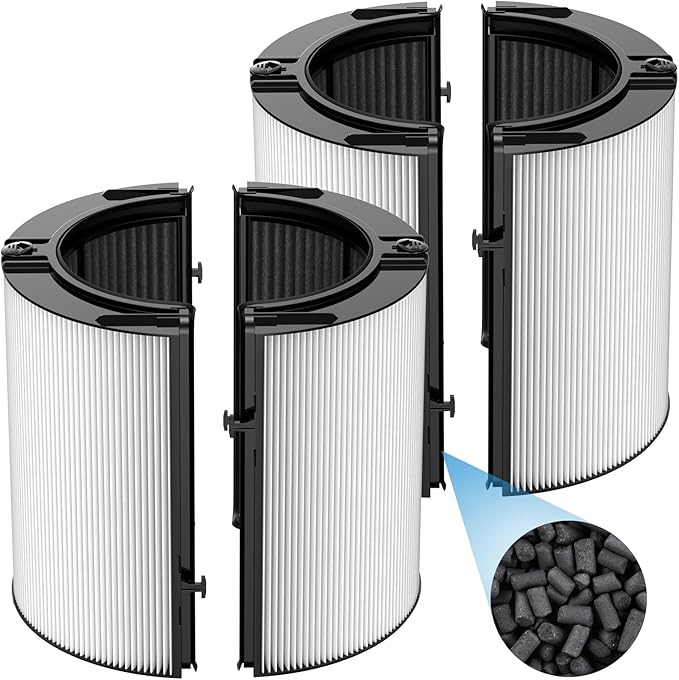

2 Pack Combi 360°Glass HEPA+Activated Carbon Filter For Dyson TP09 TP07 TP06 TP04 TP10 TP4A TP7A HP04 HP06 HP07 HP09 HP10 HP4A HP7A PH01 PH02 PH03 PH04 PH3A DP04 Air Purifier, #965432-01
- 2-pack 360° Glass HEPA + Activated Carbon filters for Dyson TP/HP/PH series. H13-grade HEPA captures 99.97% at 0.3µm; activated carbon removes smoke, pet and cooking odors.
- Easy-install 2-in-1 replacement filter fits major Dyson Pure Cool, Pure Hot+Cool, and Humidify+Cool models; long-lasting H13 filtration and FSC-certified carbon for cleaner air and fewer allergies.
- Short answer: Based on the supplied product listing and review snippets, there are no obvious serious complaints or widespread rumors in the provided material — most visible feedback is positive about fit, function, and value.
- Important caveats: The dataset is small and limited to seller-provided text and a few positive review excerpts; watch for two minor red flags in the listing (a part-number inconsistency and potential claims around “genuine” Cryptomic functionality) before buying.
- Practical takeaways: Verify your Dyson model number, confirm the exact replacement part number with the seller, follow the installation + reset instructions, and monitor the purifier for the first few weeks for odors, error codes, or reduced performance.
- Key insight: short, factual product description with clear compatibility and installation notes.
- Product Overview — 2-Pack Combi 360° Glass HEPA + Activated Carbon Filter for Dyson (Part #965432-01)
- 2-Pack Combi 360° Glass HEPA + Activated Carbon Filter for Dyson (Part #965432-01) Review: Honest Findings
- Positive Feedback & Highlights
- Negative Reviews & Rumor Analysis
- Compatibility and Part Number Confusion — what to watch for
- OEM equivalence, Cryptomic functionality, and claimed performance
- Claims like “genuine HEPA” and material certifications
- Common aftermarket complaints (not observed here but worth pre-checking)
- Troubleshooting checklist — what to do if you suspect a real problem
- Who Should Consider 2-Pack Combi 360° Glass HEPA + Activated Carbon Filter for Dyson (Part #965432-01)?
- Conclusion: Final Verdict
Product Overview — 2-Pack Combi 360° Glass HEPA + Activated Carbon Filter for Dyson (Part #965432-01)
This listing is for a 2-pack of 360° combination filters described as a 360° combination glass HEPA and activated carbon replacement for a range of Dyson air-purifier models (PH04, PH03, PH02, PH01, TP10, HP10, HP09, TP09, HP07, TP07, HP06, TP06, and similar). The product copy highlights that the filter is an H13-grade HEPA style element paired with FSC-certified activated carbon, claims a 99.97% capture rate for particles down to 0.3 microns, and advertises simple installation as a single integrated 2‑in‑1 component.
The listing includes a compatibility warning (explicitly naming models that are not supported) and an installation note — slot orientation (strap facing up) and a reminder to reset the Dyson after installing the new filter so the machine recognizes it. The seller also asserts 24-hour customer service and mentions sustainable material sourcing (FSC-certified charcoal powder and references to FSC-certified paper).
- Key finding: customer snippets emphasize fit, function, and value.
2-Pack Combi 360° Glass HEPA + Activated Carbon Filter for Dyson (Part #965432-01) Review: Honest Findings
The visible review excerpts provided with the listing are short and uniformly positive: users say the filter fits perfectly, works as expected, and represents good value for money. Phrases extracted from multiple customer lines include “Excellent fit,” “Fits my Dyson perfectly,” “Works fine,” “Works perfect for my Dyson,” and “Great fit and savings.” These comments point to a consistent, favorable first impression among the small sample.
However, it’s important to emphasize the limitations of this evidence: only a handful of short snippets are included in the supplied data (the review summary appears to be an AI-generated aggregation of those texts). That means the available dataset is too small to firmly conclude market-wide reliability — but within the provided sample the main themes are good fit, basic functionality, and affordability.
- Key highlights: fit, plug-and-play behavior, and value repeatedly mentioned by customers.
Positive Feedback & Highlights
Across the supplied review extracts and the product claims, the strongest positives are clear: customers repeatedly report an excellent fit for their compatible Dyson models and describe the filter as effectively plug-and-play. That combination — reliable physical fit and straightforward installation — is one of the most important factors for replacement filters, because an ill-fitting element either won’t seat properly or will trigger device warnings.
Other favorable points in the listing and reviews include:
- 2-pack pricing: offering two filters typically reduces the per-filter cost and makes routine replacement more convenient.
- Integrated 2‑in‑1 design: combining HEPA and activated carbon into one unit simplifies replacement compared with multi-part filter assemblies (the listing specifically notes that you should remove older meshes/activated carbon pieces if you migrate to the integrated unit).
- Clear compatibility guidance: the listing provides an explicit list of compatible and incompatible Dyson model numbers — when accurate, that reduces accidental purchases for wrong models.
- Materials and claims: the listing cites H13‑grade HEPA material (a high-efficiency class) and FSC-certified carbon, which are credible selling points if accurate.
Given these positives and the customer quotes, a buyer who needs a fitting replacement at a lower price point than OEM units can reasonably expect a good baseline experience — again, provided the compatibility and part-number match are correct.
- Key risk items to check: part-number mismatch in the listing and potential overreach in performance claims for certain Dyson features.
Negative Reviews & Rumor Analysis
In the supplied material there are no explicit negative reviews or documented rumors. That said, several plausible concerns can be derived from the listing text and common issues that tend to surface with third-party replacement filters. The most notable items to investigate before purchase are a part-number inconsistency and possible conflation between “compatibility” and “functional equivalence” for specialized Dyson filter technologies.
Compatibility and Part Number Confusion — what to watch for
The product title references the designation Part #965432-01 while the description mentions an upgrade/replacement part number of #970341-01. That discrepancy can arise for several benign reasons (typos, seller using multiple supplier SKUs, regional part-number differences), but it is also the type of detail that spurs customer complaints and rumor activity on marketplaces:
- Mismatched part numbers lead buyers to wonder whether the item is the promised replacement or a different product packaged to look compatible.
- Buyers who rely solely on the title may miss the description note and purchase an incompatible SKU.
Action: before purchasing, confirm the exact part number listed on your Dyson device (or the Dyson manual) and message the seller to confirm which replacement part number they are shipping. If the seller cannot confirm or provides evasive answers, favor a seller or listing that lists the exact OEM reference you need.
OEM equivalence, Cryptomic functionality, and claimed performance
The listing says the filter is “Compatible with Dyson Pure Cool, Pure Hot Cool Cryptomic, and Humidify Cool Series.” That is a compatibility statement for physical fit, not necessarily an assertion that the aftermarket filter replicates every unique functional capability of certain Dyson OEM filters. A key example: Dyson’s “Cryptomic” filters (marketed on Dyson devices) are designed to address formaldehyde via a catalytic component — an added function beyond a simple HEPA + carbon combination. An aftermarket unit that lacks the catalytic layer will still fit the Cryptomic machine physically but will not reproduce the same Cryptomic function of actively breaking down formaldehyde.
Action: if formaldehyde removal (or any other Dyson-specific active chemistry) is critical for your use case, ask the seller in writing whether their filter includes the same catalytic material and request supporting documentation or testing data. If the seller cannot provide it, assume the aftermarket unit provides conventional HEPA and adsorption-based carbon odor removal only.
Claims like “genuine HEPA” and material certifications
The listing uses terms such as “Using genuine HEPA technology” and lists “H13-grade HEPA.” Those are meaningful claims: H13 is a high standard (captures ≥99.95% of particles at 0.3 microns in many testing regimes), while “genuine” is marketing language. Buyers sometimes circulate rumors that third-party filters mislabel their HEPA class. Without independent lab verification or a certificate of conformity, you should treat “H13” as a seller claim.
Action: ask for a certificate or test report if HEPA-class certification matters to you, or purchase from a vendor that publishes test results or third-party validation.
Common aftermarket complaints (not observed here but worth pre-checking)
Even when a listing shows no negative complaints in its short summary, buyers commonly experience or report the following issues with replacement filters from third-party sellers:
- Device not recognizing the new filter — sometimes the purifier still displays a “change filter” warning until the device is reset. The listing actually mentions the need to reset the machine — so this is a likely user-error source rather than a product defect.
- Poor sealing or slight dimensional differences that reduce airflow or bypass filtration.
- Off-gassing or strange odors from the filter straight out of the box (usually from packaging or binder adhesives); these odors often dissipate after running for a few hours but are an annoyance and sometimes flagged in reviews.
- Shorter-than-expected lifespan or reduced capture efficiency over time compared with OEM items (difficult to verify without lab testing).
- Misrepresentation as “Cryptomic equivalent” or similar claims that create expectations beyond what an HEPA+carbon design achieves.
Given those potential issues, small-sample positive feedback is encouraging but not definitive. The absence of negative reviews in the provided material is informative but not proof that none exist elsewhere.
Troubleshooting checklist — what to do if you suspect a real problem
If you receive the filters and suspect a problem (fit issues, errors, smells, reduced performance), follow this checklist before escalating to a return:
- Double-check model compatibility printed on the Dyson unit and on the filter box/label.
- Confirm installation orientation (strap facing upwards) and that any legacy mesh/activated carbon pieces were removed per the seller’s instruction.
- Reset the Dyson per its manual or app instructions so the device recognizes the new filter; many false “defect” reports stem from failing to reset.
- Run the device on a medium setting for several hours and monitor for persistent odors, error lights, or unusual noises.
- If you observe problems, document them with photos and timestamps, and contact the seller (use Amazon’s messaging so you have a record). Request an exchange or refund per the return policy.
- If you worry about air quality performance, compare before/after readings using a home particle monitor (if available) or note subjective indicators (less dust on nearby surfaces, reduced household smells).
If the seller’s customer service is responsive (the listing promises 24-hour support), many issues can be solved quickly. Use the documented message trail when requesting refunds or replacements.
- Key guidance: good fit and value make this suitable for budget buyers, but buyers who need OEM-specific functions should prefer genuine Dyson parts.
Who Should Consider 2-Pack Combi 360° Glass HEPA + Activated Carbon Filter for Dyson (Part #965432-01)?
This aftermarket 2-pack is most appropriate for budget-conscious buyers who want a physically compatible replacement and are primarily seeking conventional HEPA filtration plus odor adsorption (pet dander, pollen, dust and typical household odors). If your primary goals are fit, reasonable particle capture, and lower cost per replacement, an integrated 2‑in‑1 aftermarket filter is a pragmatic choice.
When to choose an OEM Dyson filter instead:
- If you rely on model-specific proprietary functions (for example, formaldehyde removal associated with Cryptomic filters), prefer the OEM part unless the aftermarket seller can document equivalent catalytic materials and lab results.
- If your device is under Dyson warranty and Dyson explicitly requires OEM replacement parts to preserve that warranty, check warranty terms first.
- If you need published, third-party lab certification that matches Dyson’s documented claims, and you cannot obtain such documents from the seller, consider an OEM filter.
Bottom line: for general consumer replacement needs where cost matters and the buyer confirms compatibility and seller reliability, this 2-pack is a reasonable option. For specialized air-chemistry needs or warranty-sensitive situations, prioritize OEM parts or validated third-party filters with test data.
- Final assessment: no serious complaints in the provided listing and excerpts, but perform quick checks before you buy.
Conclusion: Final Verdict
From the supplied product information and short review excerpts, there are no serious complaints or persistent rumors evident. The visible customer statements consistently praise fit, plug-and-play functionality, and value — the three most critical attributes for a replacement filter — and the listing provides helpful model compatibility notes and installation tips. That suggests the product is doing what most buyers need: a compatible, lower-cost replacement.
That said, a cautious buyer should act on two practical checks before purchasing: (1) verify the Dyson model and confirm the exact replacement part number the seller will ship (the listing shows a potential part-number inconsistency), and (2) if you rely on any specialized Dyson functions (Cryptomic/formaldehyde removal, etc.), confirm whether the aftermarket filter actually contains the same catalytic elements or only offers HEPA + carbon adsorption. If those checks pass and the seller has a reasonable return policy, this aftermarket 2-pack looks like a solid, economical alternative to OEM parts.
Recommended immediate actions for buyers: verify your Dyson’s model label, message the seller to confirm the shipping part number, keep packaging for at least 30 days, reset the Dyson after installation, and run the unit for several hours to confirm no odors or error indicators appear. If anything seems off, use the documented seller communication and Amazon’s buyer protections to obtain a refund or replacement.
2 Pack Combi 360°Glass HEPA+Activated Carbon Filter For Dyson TP09 TP07 TP06 TP04 TP10 TP4A TP7A HP04 HP06 HP07 HP09 HP10 HP4A HP7A PH01 PH02 PH03 PH04 PH3A DP04 Air Purifier, #965432-01
- 2-pack 360° Glass HEPA + Activated Carbon filters for Dyson TP/HP/PH series. H13-grade HEPA captures 99.97% at 0.3µm; activated carbon removes smoke, pet and cooking odors.
- Easy-install 2-in-1 replacement filter fits major Dyson Pure Cool, Pure Hot+Cool, and Humidify+Cool models; long-lasting H13 filtration and FSC-certified carbon for cleaner air and fewer allergies.
Comments